
CUETMOCK
  • Pricing
  • Mentors
Log inStart freeStart free mocks→

First test, then trust

Try a free CUET mock test.

Join 5,00,000+ students who rehearsed exam day on the exact NTA screen before sitting CUET. On the web and on Android.

Start free mocks →Get the Android app
CUETMOCK

India's #1 CUET Mock Test Platform. Original NCERT-based questions on the exact NTA exam screen — trusted by 5,00,000+ students since CUET 2022.

Get it onGoogle PlayScan to download the CUETMOCK app

Mock tests

  • CUET mock test series
  • Browse all papers
  • Commerce mocks
  • Humanities (Arts) mocks
  • Science mocks
  • Languages & GAT mocks
  • Free practice questions
  • Pricing

Resources

  • CUET exam guide
  • CUET syllabus
  • Universities accepting CUET
  • Expert blogs
  • News & notifications
  • Webinars & counselling
  • CUET score calculator
  • How we estimate your rank
  • FAQs

Company

  • About us
  • Our leadership & team
  • Our toppers
  • Mentors
  • For schools
  • Contact us
  • Terms
  • Privacy
  • Refund policy

Talk to us

+91 7696 6630 56info@cuetmock.comWhatsApp us

Our other platforms

  • JEE Mock — For IIT-JEE aspirants
  • NEET Mock — For NEET aspirants

Newsletter

Exam updates, study material and offers — no spam.

© 2026 NYC Ventures Pvt. Ltd.

701-702, Royal Business Park, Zirakpur, Punjab - 140603

  • Terms of use
  • Privacy policy
  • Refund policy
  • Contact us

iCUETMOCK is an independent preparation platform, not affiliated with the National Testing Agency (NTA). Always check exam details on the official NTA website.

  • Home
  • Mock tests
  • CUET guide
  • Pricing
  • Log in
Home/Practice questions/Biology
BiologyMicrobes in Human Welfare

The type of microbe that can be grown on only nutritive media and for…

Observe the given figure and answer the question.
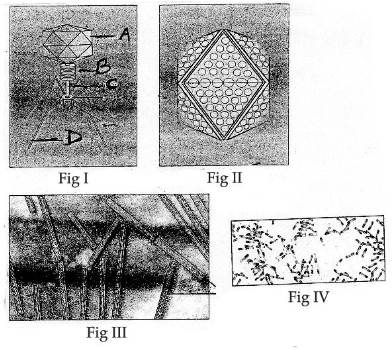
Microbes: Fig I bacteriophage, Fig II, Fig III and Fig IV

The type of microbe that can be grown on only nutritive media and form colonies shown in:

Answer & explanation+

Correct answer: option 4

The correct answer is Option (4) → Fig IV

Viruses grow only inside living cells, so they cannot form colonies on nutritive media. Bacteria can. Fig IV shows rod-shaped bacteria; Figs I, II and III are viruses.

Option (4) Fig IV — Correct. Bacteria grow on nutritive media and form colonies that can be seen with the naked eye. The figure that shows such colonies, Fig IV, is the answer.

NCERT Extract:
Microbes in Human Welfare – “… Microbes like bacteria and many fungi can be grown on nutritive media to form colonies (Figure 8.3), that can be seen with the naked eyes. Such cultures are useful in studies on micro-organisms.”

Advertisement

Practise more on Microbes in Human Welfare

Chapter-wise mocks on the real NTA exam screen, with solutions and your rank. Your first mocks are free.

Start free mocks →

Advertisement

Next questions

  1. Select the option that is related to the third term in the same way as the second term is related to the first term. ITEM : METI : : ACHE :…General Aptitude Test · General Ability
  2. Which among the following are seen as ‘beads-on-string’ structure when viewed under electron microscope ?Biology · Molecular Basis of Inheritance
  3. Which of the following is known as the simplest monosaccharide?Chemistry · Organic: Biomolecules
  4. The dimensions of rate constant of second-order reaction involves which of the following?Chemistry · Physical: Chemical Kinetics
  5. When a number is increased by x%, by what percent the resultant should be decreased in order to get original number?General Aptitude Test · Numerical Ability
  6. In what ratio must a shopkeeper mix peas and soyabean of ₹16 and ₹25 per kg respectively, so as to obtain a mixture of ₹19 per kg?General Aptitude Test · Numerical Ability
  7. The average weight of 60 students in a class is 56.4 kg. If 12 students having average weight 59.5 kg leave the class and 15 students havin…General Aptitude Test · Numerical Ability
  8. What is the product obtained when glucose is reduced in the presence of sodium amalgam?Chemistry · Organic: Biomolecules
  9. Which of the following statements about the zamindar under the Permanent Settlement introduced by the British in India is correct?History · Modern India: Colonialism and the Countryside
  10. Maths. Section B1 · Matrices