
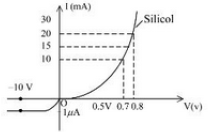
The V-I characteristics of a silicon diode is shown in the figure. The resistance of the diode at \( V_D = -10\,\mathrm{V} \) is
Answer & explanation
Correct answer: option 4
The correct answer is Option (4) → \( 1.0\times10^{7}\,\Omega \)
The resistance of a diode at a given voltage is the ratio of that voltage to the current read from the V-I characteristic, \( R = V_D/I \). At \( V_D = -10\,\mathrm{V} \) the diode is reverse biased, and the graph shows a reverse current of \( 1\,\mu\mathrm{A} \) there.
\( I = 1\,\mu\mathrm{A} = 1\times10^{-6}\,\mathrm{A} \)
\( \displaystyle R = \frac{V_D}{I} = \frac{10\,\mathrm{V}}{1\times10^{-6}\,\mathrm{A}} = 1.0\times10^{7}\,\Omega \)
Note: This question is from NCERT (2026-27). NTA sets numerical questions from NCERT too, so do not ignore NCERT while practising numericals.
NCERT (2026-27):
p-n Junction Diode Under Reverse Bias – …
