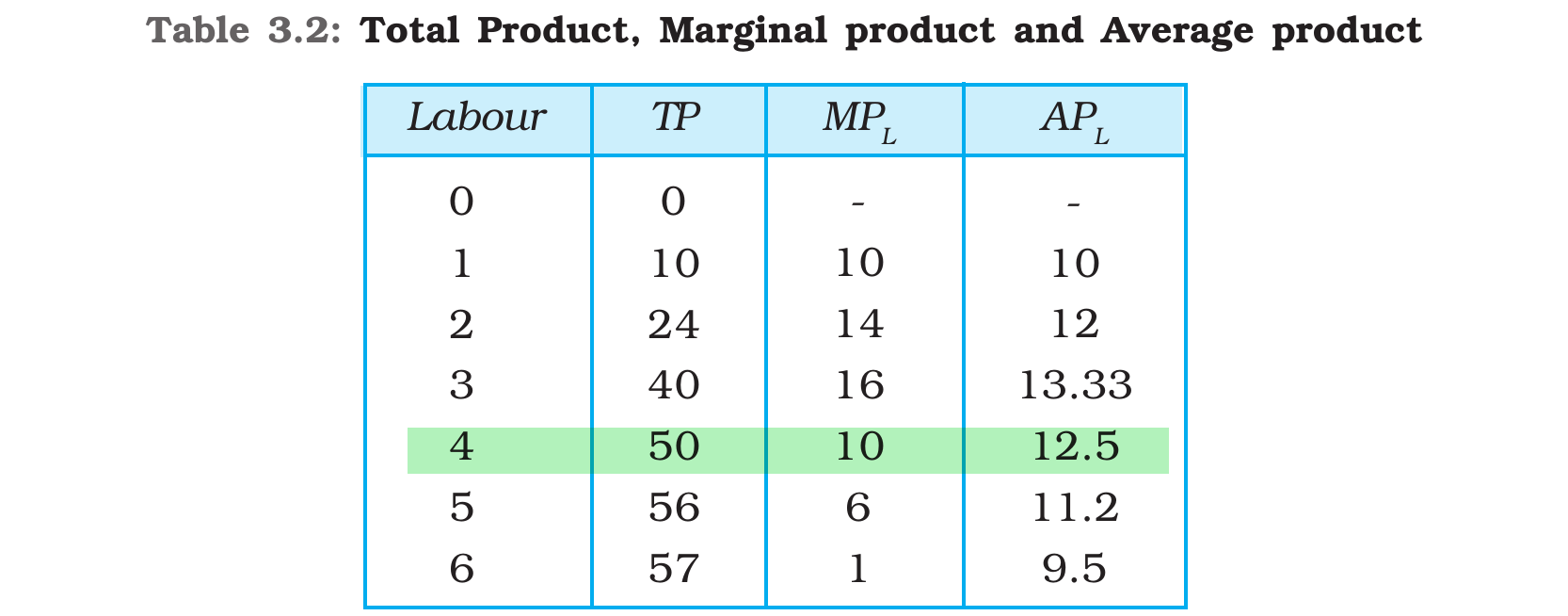
When more workers are hired, the land begins to get 'crowded'. Each worker now has insufficient land to work efficiently. So the output added by each additional worker is now proportionally less as a result the marginal product begins to ____.
Answer & explanation
Correct answer: option 3
The correct answer is Option (3) → Fall
When the land gets ‘crowded’, each additional worker adds proportionally less to output. So the marginal product begins to fall.
Marginal product is the change in output from one more unit of an input, with the other inputs held constant. On a farm with fixed land, marginal product first rises as more workers are hired, and later falls. This tendency is the law of variable proportions, also called the law of diminishing marginal product.
NCERT (2026-27): “3.4 The Law of Diminishing Marginal Product and the Law of Variable Proportions …This tendency of the MP to first increase and then fall is called the law of variable proportions or the law of diminishing marginal product. Law of variable proportions say that the marginal product of a factor input initially rises with its employment level. But after reaching a certain level of employment, it starts falling.… …Suppose table 3.2 describes the output of a farmer who has 4 hectares of land, and can choose how much labour he wants to use. If he uses only 1 worker, he has too much land for the worker to cultivate alone. As he increases the number of workers, the amount of labour per unit land increases, and each worker adds proportionally more and more to the total output. Marginal product increases in this phase. When the fourth worker is hired, the land begins to get ‘crowded’. Each worker now has insufficient land to work efficiently. So the output added by each additional worker is now proportionally less. The marginal product begins to fall.…”
|