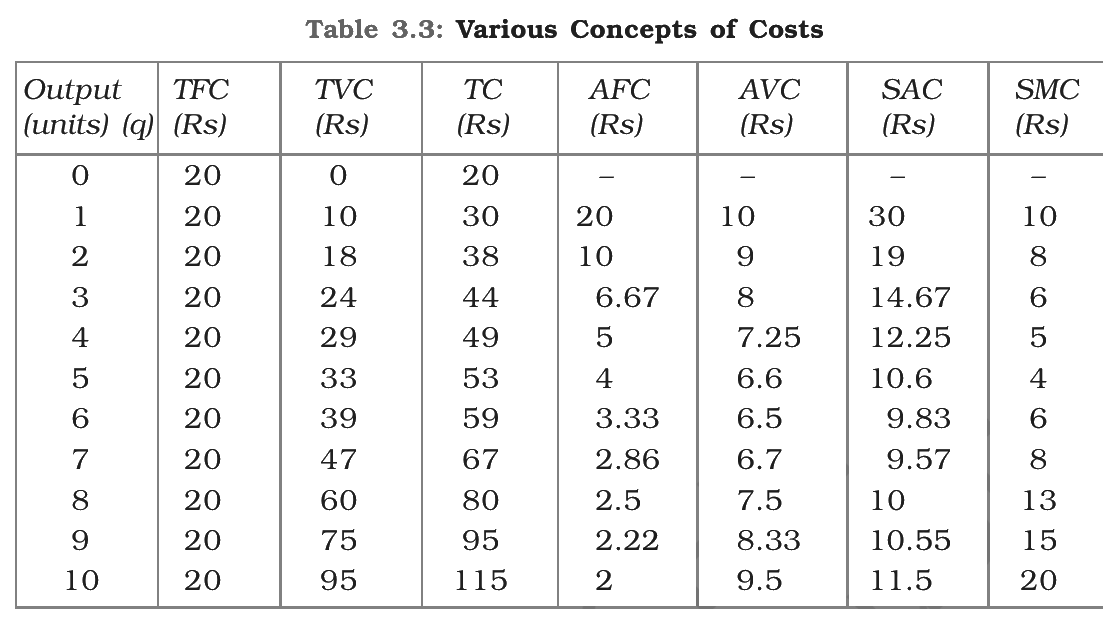
Study the table below and answer the question.
| Output (units) | TFC (Rs) | TVC (Rs) | TC (Rs) |
|---|---|---|---|
| 0 | 20 | 0 | 20 |
| 1 | 20 | 10 | 30 |
| 2 | 20 | 18 | 38 |
| 3 | 20 | 24 | 44 |
| 4 | 20 | 29 | 49 |
| 5 | 20 | 33 | 53 |
| 6 | 20 | 39 | 59 |
What will be the AVC at zero output?
Answer & explanation
Correct answer: option 3
The correct answer is Option (3) → undefined
AVC is TVC divided by output. At zero output both TVC and output are 0, and 0 divided by 0 cannot be worked out. So AVC has no value there.
It is not 0: a zero TVC does not give a zero average when there is no unit to share it over.
NCERT (2026-27): “3.7.1 Short Run Costs … In Table 3.3, we get the AFC-column by dividing the values of the second column by the corresponding values of the first column. Similarly, we get the AVC-column by dividing the values of the third column by the corresponding values of the first column. At zero level of output, both AFC and AVC are undefined. For the first unit of output, AFC is Rs 20 and AVC is Rs 10. Adding them, we get the SAC equal to Rs 30.”
|