
CUETMOCK
  • Pricing
  • Mentors
Log inStart freeStart free mocks→

First test, then trust

Try a free CUET mock test.

Join 5,00,000+ students who rehearsed exam day on the exact NTA screen before sitting CUET. On the web and on Android.

Start free mocks →Get the Android app
CUETMOCK

India's #1 CUET Mock Test Platform. Original NCERT-based questions on the exact NTA exam screen — trusted by 5,00,000+ students since CUET 2022.

Get it onGoogle PlayScan to download the CUETMOCK app

Mock tests

  • CUET mock test series
  • Browse all papers
  • Commerce mocks
  • Humanities (Arts) mocks
  • Science mocks
  • Languages & GAT mocks
  • Free practice questions
  • Pricing

Resources

  • CUET exam guide
  • CUET syllabus
  • Universities accepting CUET
  • Expert blogs
  • News & notifications
  • Webinars & counselling
  • CUET score calculator
  • How we estimate your rank
  • FAQs

Company

  • About us
  • Our leadership & team
  • Our toppers
  • Mentors
  • For schools
  • Contact us
  • Terms
  • Privacy
  • Refund policy

Talk to us

+91 7696 6630 56info@cuetmock.comWhatsApp us

Our other platforms

  • JEE Mock — For IIT-JEE aspirants
  • NEET Mock — For NEET aspirants

Newsletter

Exam updates, study material and offers — no spam.

© 2026 NYC Ventures Pvt. Ltd.

701-702, Royal Business Park, Zirakpur, Punjab - 140603

  • Terms of use
  • Privacy policy
  • Refund policy
  • Contact us

iCUETMOCK is an independent preparation platform, not affiliated with the National Testing Agency (NTA). Always check exam details on the official NTA website.

  • Home
  • Mock tests
  • CUET guide
  • Pricing
  • Log in
Home/Practice questions/Fine Arts
Fine ArtsThe Bengal School and Cultural Nationalism

In what year did Gaganendranath Tagore create the painting shown abov…

Based on the picture shown below answer the questions asked:
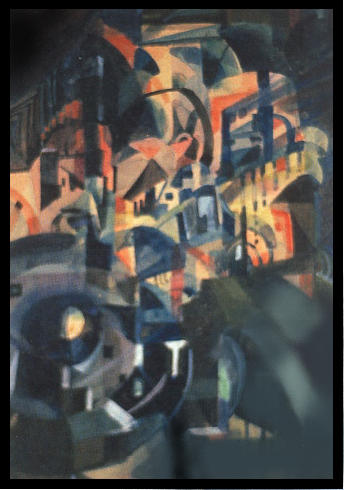
In what year did Gaganendranath Tagore create the painting shown above?

1) 1855
2) 1922
3) 1938
4) 1869

Answer & explanation+

Correct answer: option 2

The correct answer is Option 2- 2 (1922)

Gaganendranath Tagore visualized the mysterious world of his imaginary cities, including Dwarka, which is Lord Krishna’s legendary abode.

City In The Night: This is a watercolour painting made by Gaganendranath Tagore (1869 –1938) in 1922. He was one of the earlier Indian painters, who made use of language and syntax of Cubism to render his ideas. The inner experiences of turbulence are externalised through a blend of allegorical and formal, transforming the static geometry of Analytical Cubism into an expressive apparatus. He softened Cubism’s formal geometry with a seductive profile, shadow or outline of human form. He visualised the mysterious world of his imaginary cities like Dwarka (Lord Krishna’s legendary abode) or Swarnapuri (The Golden City) through multiple viewpoints, multi-faceted shapes and jagged edges of Cubism. He painted an interplay of diamond-shaped planes and prismatic colours, resulting in fragmented luminosity to render the mountain ranges of the city. Zigzag planes together are able to create a tight formal structure of the painting. The painting is mysteriously illuminated by artificial light, one of the features of theatre. It shows his involvement with his uncle Rabindranath Tagore’s play staged in their house. The painter has taken many references of stage props, partition screens, overlapping planes and artificial stage lighting. Endless corridors, pillars, halls, half-open doors, screens, illuminated windows, staircases and vaults are painted on the same plane to conjure a magic world.

Advertisement

Practise more on The Bengal School and Cultural Nationalism

Chapter-wise mocks on the real NTA exam screen, with solutions and your rank. Your first mocks are free.

Start free mocks →

Advertisement

Next questions

  1. Which statements about the duration of psychotherapies are correct?A. Classical psychoanalysis may continue for several years.B. Several re…Psychology · Therapeutic Approaches
  2. A plane monochromatic light falls normally on a diaphragm with two narrow slits separated by a distance d = 2.5 mm. A fringe pattern is for…Physics · Ray Optics
  3. To solve any kind of problems, and remain focused, the human brain uses _____ waves.English · Comprehension - (Narrative / Factual)
  4. Match the coordination compounds given in List-I with the central metal atoms given in List-II List-I Coordination compound List-II Central…Chemistry · Inorganic: Coordination Compounds
  5. Arrange the given words in the sequence in which they occur in the dictionary. 1.Taken 2. Tactless 3. Tackle 4. Tactful 5. TalentGeneral Aptitude Test · Verbal Reasoning
  6. What part of the insect pest does the Bt toxin target?Biology · Biotechnology and its Applications
  7. Identify the correct options with respect to the salient features of DNA.(A) The two polynucleotide chains are coiled in a left-handed fash…Biology · Molecular Basis of Inheritance
  8. The function f(x)=(x^2-25)/((x+5)),\ x ≠ -5 is:Maths. Section B1 · Continuity and Differentiability
  9. निम्नलिखित में से रीतिकाल के कवि हैं -(A) भूषण(B) कबीर(C) पद्माकर(D) मतिराम(E) मलिक मुहम्मद जायसीनीचे दिए गए विकल्पों में से सही उत्तर चुनि…Hindi · हिंदी साहित्य (रचना, रचनाकार और विधाएँ)
  10. निम्नलिखित साहित्यकारों को कालक्रमिक रूप से व्यवस्थित कीजिये -A. बालकृष्ण भट्टB. रामचंद्र शुक्लC. महावीर प्रसाद द्विवेदीD. रामविलास शर्मानी…Hindi · हिंदी साहित्य (रचना, रचनाकार और विधाएँ)