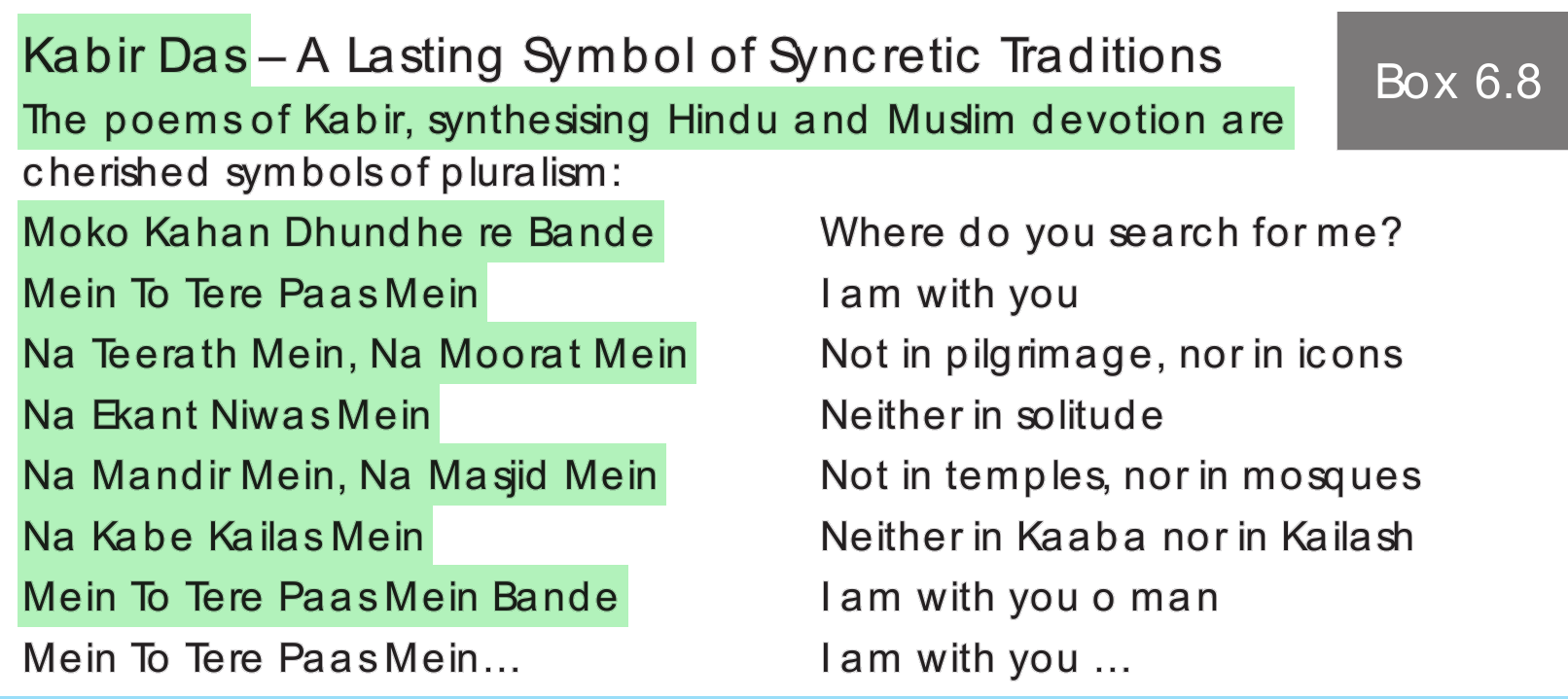
Consider the following poem by Bhakti Saint Kabirdas:
Where do you search for me?
I am with You
Not in pilgrimage, nor in icons
Neither in solitude
Not in temples, nor in mosques
Neither in Kaaba, nor in Kailash
I am with you o man
I am with you
Which tradition does this poem reflect:
Answer & explanation
Correct answer: option 1
The correct answer is Option (1) → Syncretic Tradition
Option (1) Syncretic Tradition — Correct. Syncretism is the inter-mixing of different religious traditions. Kabir’s poem finds God neither in temples nor in mosques, neither in Kaaba nor in Kailash, but with the human being. His poems, synthesising Hindu and Muslim devotion, are cherished symbols of this syncretic heritage of the Bhakti and Sufi movements.
Option (2) Muslim Tradition — Incorrect. The poem sets aside the mosque and the Kaaba just as it sets aside the temple and Kailash, so it cannot belong to the Muslim tradition alone.
Option (3) Hindu Tradition — Incorrect. In the same way, the poem looks beyond pilgrimage, icons, temples and Kailash, which are Hindu places and forms of worship; it does not speak for one religion.
Option (4) Din-E-Ilahi Tradition — Incorrect. Din-i-Ilahi was the faith that the Mughal emperor Akbar put forward at his court, drawing on several religions. Kabir’s poem comes from the devotional Bhakti tradition of the common people, not from Akbar’s court faith.
NCERT: Indian Society — Chapter 6: The Challenges of Cultural Diversity (2025-26)
|