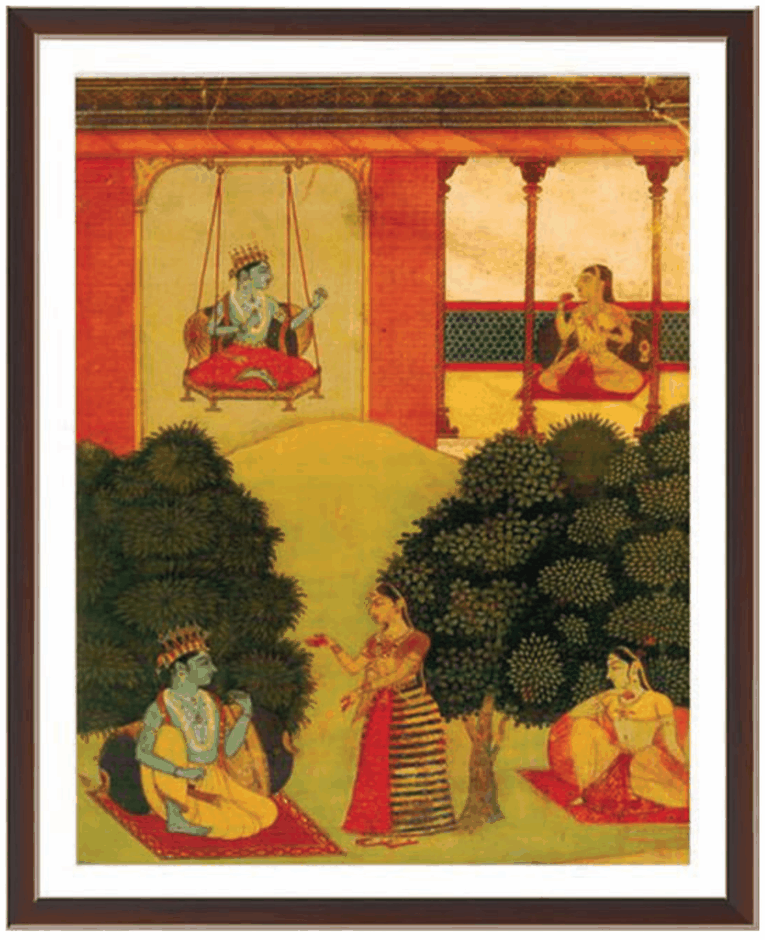
Observe the image and answer the following question.
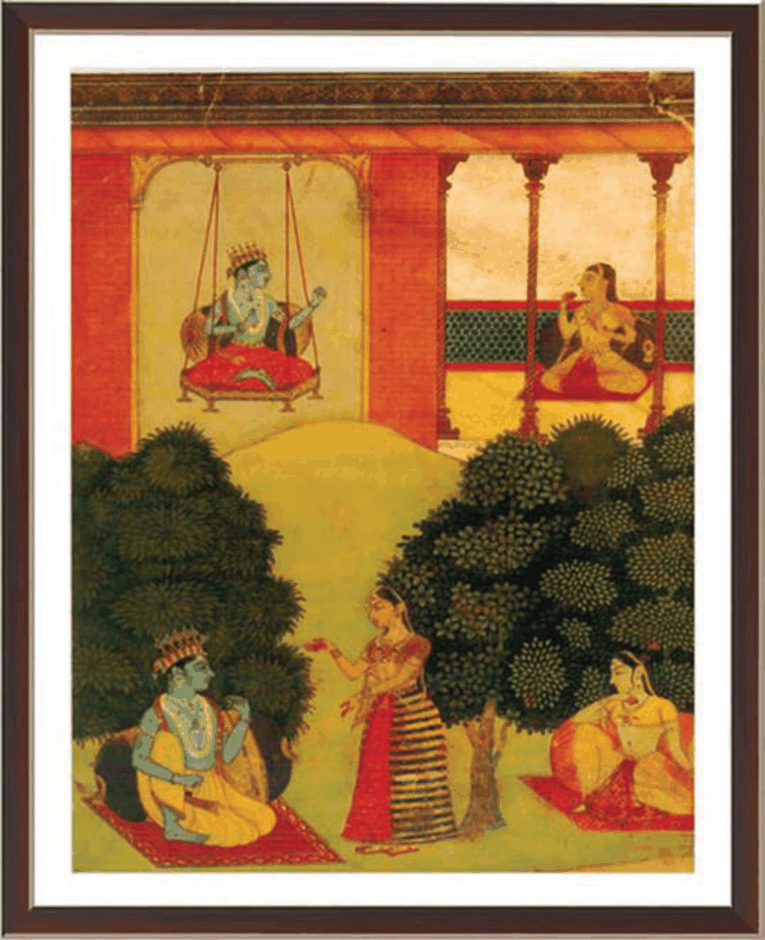
The painting in the image illustrates the Rasikapriya and was painted by Nuruddin in 1683. What does the soft undulating mound in this painting do?
Answer & explanation
Correct answer: option 2
The correct answer is Option (2) → It divides the painting into two sections
Option (1) It gives an oblique aerial perspective to the scene — Incorrect. Oblique aerial perspective is the device Sahibdin crafted in the Yuddha Kanda of Mewar, to give credibility to the scale of war pictures.
Option (2) It divides the painting into two sections — Correct. Nuruddin used the soft undulating mound in the centre to divide the painting into two sections. It also turns the urban setting into a tree-laden countryside.
Option (3) It qualifies the upper space as the palatial interior — Incorrect. The architectural pavilion in the upper part, not the mound, qualifies that space as the palatial interior.
Option (4) It layers several episodes into a single painting — Incorrect. Layering several episodes into a single painting is a narrative technique of Sahibdin in the Yuddha Kanda of Mewar. The mound here is used to divide the painting.
Note: This topic was not named in the CUET 2026 syllabus, but it was part of the NCERT chapter. In 2025 and 2026, NTA also asked questions on topics in NCERT that the CUET syllabus did not name. So our mocks have questions from every part of the NCERT chapter, to give you enough practice. Read the whole chapter, not only the sub-topics named in the syllabus.
NCERT (2026-27): “Krishna Swinging and Radha in Sad Mood …Nuruddin has ingeniously employed the device of soft undulating mound in the centre to divide the painting into two sections. It operates as a pictorial prop that transforms an urban setting into a tree-laden countryside and vice versa. An architectural pavilion in the upper part of the painting pictorially qualifies that space as the ‘palatial interior’, while few trees on the green grassland suggest ‘outdoors and pastoral’ landscape.”
|