Identify the entries which are correct:
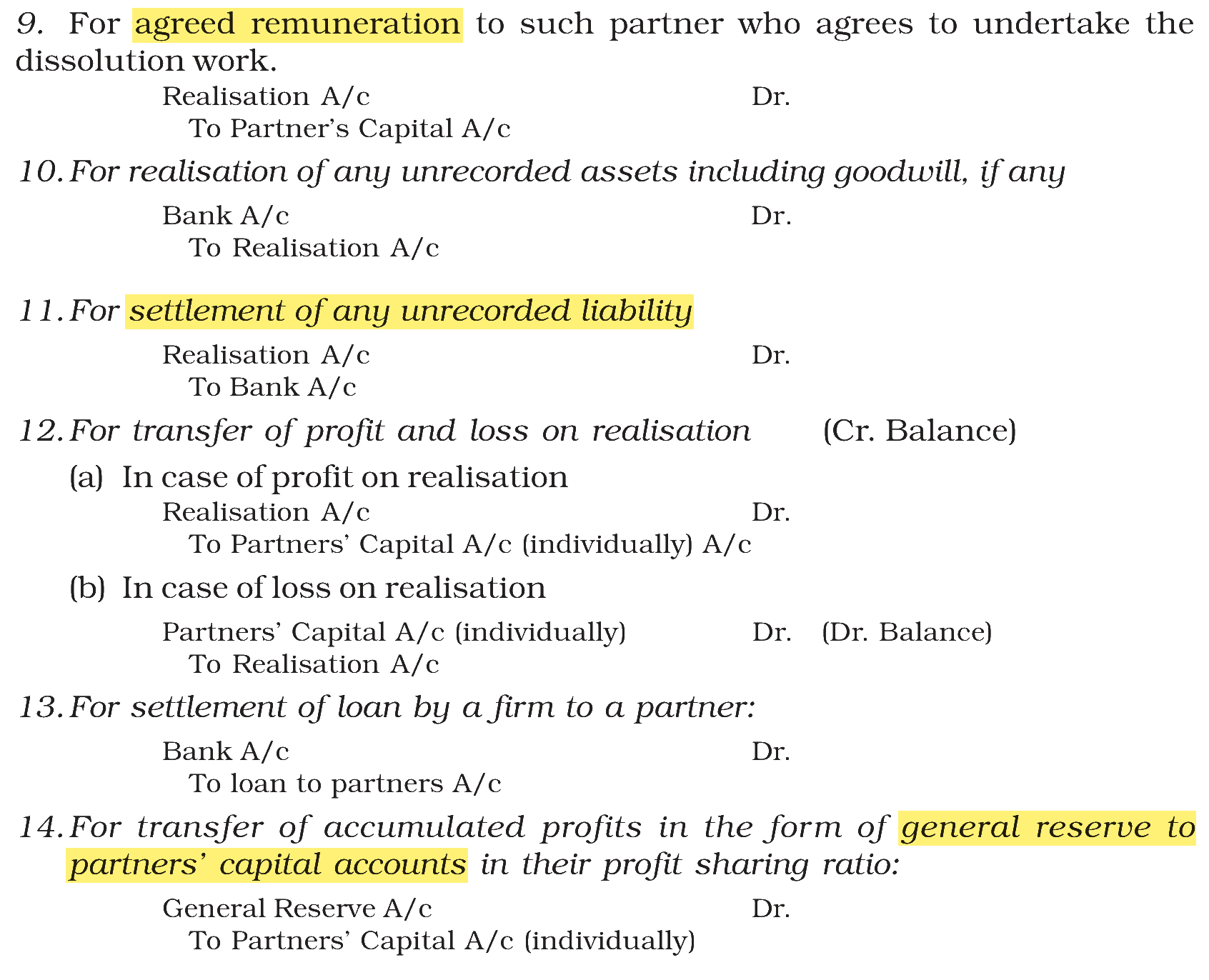
(A) For remuneration of partner - Debit Realisation A/c and Credit Partner's Capital A/c
(B) For sale of assets - Debit Realisation A/c and Credit Bank A/c
(C) For settlement of unrecorded liability - Debit Realisation A/c and Credit Bank A/c
(D) For transfer of general reserve - Debit General Reserve A/c and Credit Partners' Capital A/c
Choose the correct answer from the options given below:
Answer & explanation
Correct answer: option 4
The correct answer is Option (4) → (A), (C) and (D) only
On dissolution, Realisation Account is debited with whatever the firm spends or owes in winding up, and credited with whatever it receives for its assets.
(A) For remuneration of partner - Debit Realisation A/c and Credit Partner’s Capital A/c Correct. The remuneration is a cost of realisation, and it is owed to the partner, so it is credited to his capital account.
(B) For sale of assets - Debit Realisation A/c and Credit Bank A/c Incorrect. The entry is reversed. Cash comes in on a sale, so Bank A/c is debited and Realisation A/c is credited.
(C) For settlement of unrecorded liability - Debit Realisation A/c and Credit Bank A/c Correct. Paying a liability that was never in the books is a loss to be charged to realisation, and the cash goes out of Bank.
(D) For transfer of general reserve - Debit General Reserve A/c and Credit Partners’ Capital A/c Correct. General reserve is accumulated profit belonging to the partners. It does not pass through Realisation Account; it is credited to their capital accounts in the profit sharing ratio.
NCERT (2026-27 edition):
|