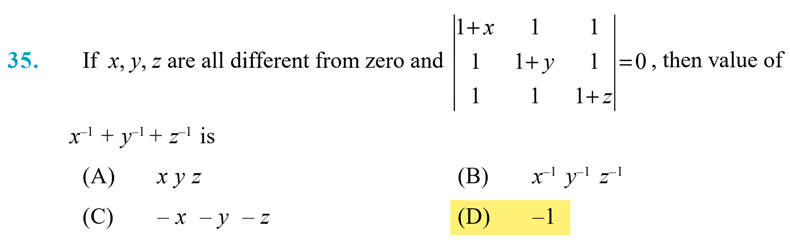
If \( x,y,z \) are all different from zero and \( \begin{vmatrix}1+x & 1 & 1\\1 & 1+y & 1\\1 & 1 & 1+z\end{vmatrix}=0 \), then the value of \( x^{-1}+y^{-1}+z^{-1} \) is
Answer & explanation
Correct answer: option 2
The correct answer is Option (2) → \( -1 \)
Expanding along the first row,
\( \displaystyle (1+x)\left[(1+y)(1+z)-1\right]-1\left[(1+z)-1\right]+1\left[1-(1+y)\right]=0 \)
\( \displaystyle (1+x)(y+z+yz)-z-y=0 \)
\( \displaystyle y+z+yz+xy+xz+xyz-z-y=0 \)
\( \displaystyle xy+yz+zx+xyz=0 \)
Since x, y, z are non-zero, dividing by xyz,
\( \displaystyle \frac{1}{z}+\frac{1}{x}+\frac{1}{y}+1=0 \)
\( \displaystyle x^{-1}+y^{-1}+z^{-1}=-1 \)
Tip: The result \( \begin{vmatrix}1+x & 1 & 1\\1 & 1+y & 1\\1 & 1 & 1+z\end{vmatrix}=xyz\left(1+\frac{1}{x}+\frac{1}{y}+\frac{1}{z}\right) \) is worth remembering; it appears often.
NCERT Exemplar:
Determinants