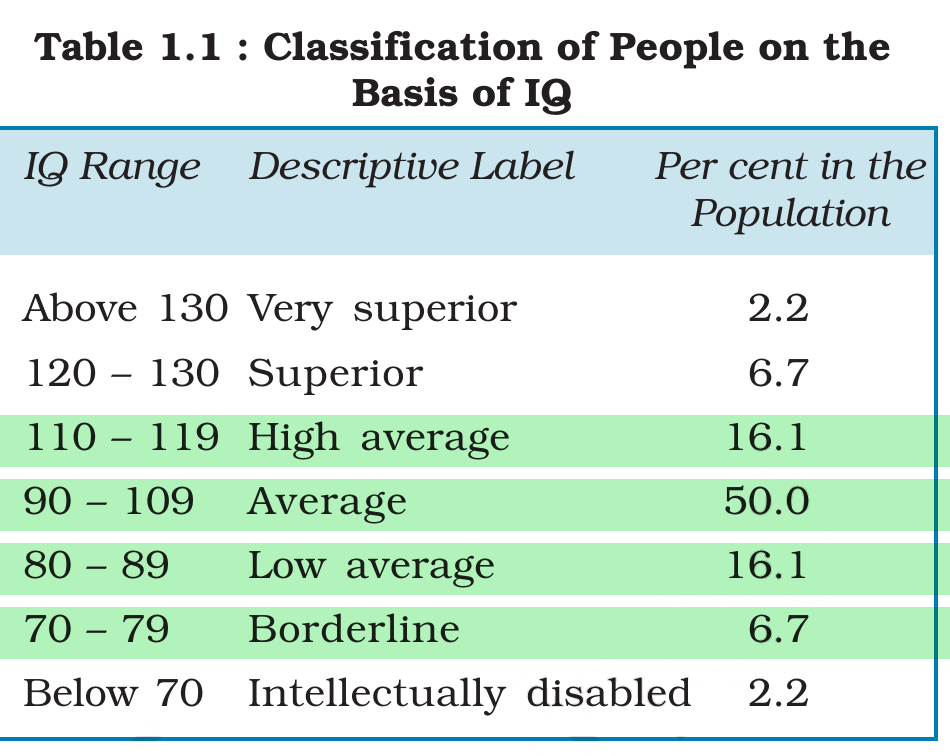
Match List-I with List-II.
| List-I | List-II | ||
| Description | IQ range | ||
| (A) | Borderline | (I) | 80 - 89 |
| (B) | High average | (II) | 70 - 79 |
| (C) | Low average | (III) | 90 - 109 |
| (D) | Average | (IV) | 110 - 119 |
Choose the correct answer from the options given below:
Answer & explanation
Correct answer: option 3
The correct answer is Option (3) → (A) - (II), (B) - (IV), (C) - (I), (D) - (III)
The IQ score of a person is interpreted with the classification of people on the basis of IQ; the mean IQ in a population is 100.
(A) Borderline — this matches (II) 70 - 79. It lies just above the range below 70, where persons are judged intellectually disabled.
(B) High average — this matches (IV) 110 - 119. It is the band just above the average range.
(C) Low average — this matches (I) 80 - 89. It is the band just below the average range.
(D) Average — this matches (III) 90 - 109. Half the population (50 per cent) falls in this central range around the mean of 100.
NCERT (2025-26): “Individual Differences in Intelligence … The mean IQ score in a population is 100. People with IQ scores in the range of 90–110 have normal intelligence. Those with IQ below 70 are suspected to have ‘intellectual disability’, while persons with IQ above 130 are considered to have exceptional talents. The IQ score of a person can be interpreted by referring to Table 1.1.…”
|