
Maximise and Minimise $Z=3x-4y$ subject to $x-2y≤0, - 3x + y ≤4 x-y≤ 6, x, y ≥ 0$.
Answer & explanation
Correct answer: option 3
The correct answer is Option (3) → Maximum = 12, Minimum = -16
Given LPP is
Maximise and minimise $Z = 3x - 4y$ subject to
$x-2y≤0$ ...(i)
|
x |
0 |
2 |
|
y |
0 |
1 |
$- 3x + y ≤ 4$ ...(ii)
|
x |
0 |
-4/3 |
|
y |
4 |
0 |
$x-y≤6$ ...(iii)
|
x |
0 |
6 |
|
y |
-6 |
0 |
and $x, y ≥0$ ...(iv)
From the graph, we see that AOB is open unbounded region whose corners are $O(0, 0), A(0, 4), B(12,6)$.
Let us evaluate the value of Z
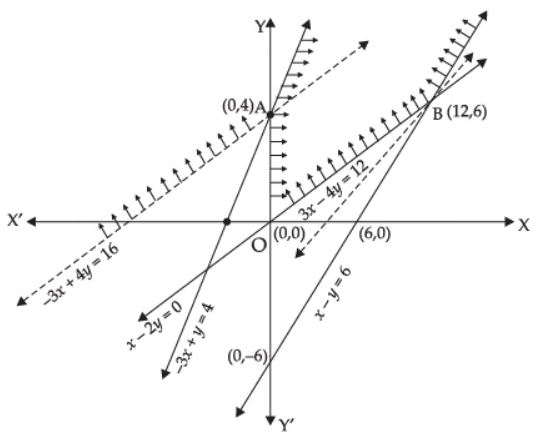
|
Corner points |
Value of $Z=3x-4y$ |
|
O(0, 0) |
$Z=0$ |
|
A(0, 4) |
$Z=0-4(4)=-16$ ← Minimum |
|
B(12, 6) |
$Z=3(12)-4(6)=12$ ← Maximum |
For this unbounded region, the value of Z may or may not be -16. So to decide it, we draw a graph of inequality $3x - 4y <- 16$ and check whether the open half plane has common points with feasible region or not. But from the graph, we see that it has common points with the feasible region, so it will have not minimum value of Z. Similarly for maximum value, we draw the graph of inequality $3x - 4y > 12$ in which there is no common point with the feasible region.
Hence, the maximum value of Z is 12.