Match List-I with List-II
|
List-I Category of Share Capital |
List-II Meaning |
|
(A) Authorised Capital |
(I) Only available to creditors at the time of winding up of a company |
|
(B) Issued Capital |
(II) The amount of capital that a company can raise in its life-time |
|
(C) Subscribed Capital |
(III) Capital that is issued to the public for subscription |
|
(D) Reserve Capital |
(IV) May be equal to or less than issued capital |
Choose the correct answer from the options given below:
Answer & explanation
Correct answer: option 1
The correct answer is Option (1) → (A)-(II), (B)-(III), (C)-(IV), (D)-(I)
Share capital is described in layers, each one a part of the layer above it: authorised, then issued, then subscribed, then called up and paid up. Reserve capital is a special slice of the uncalled amount kept back for winding up.
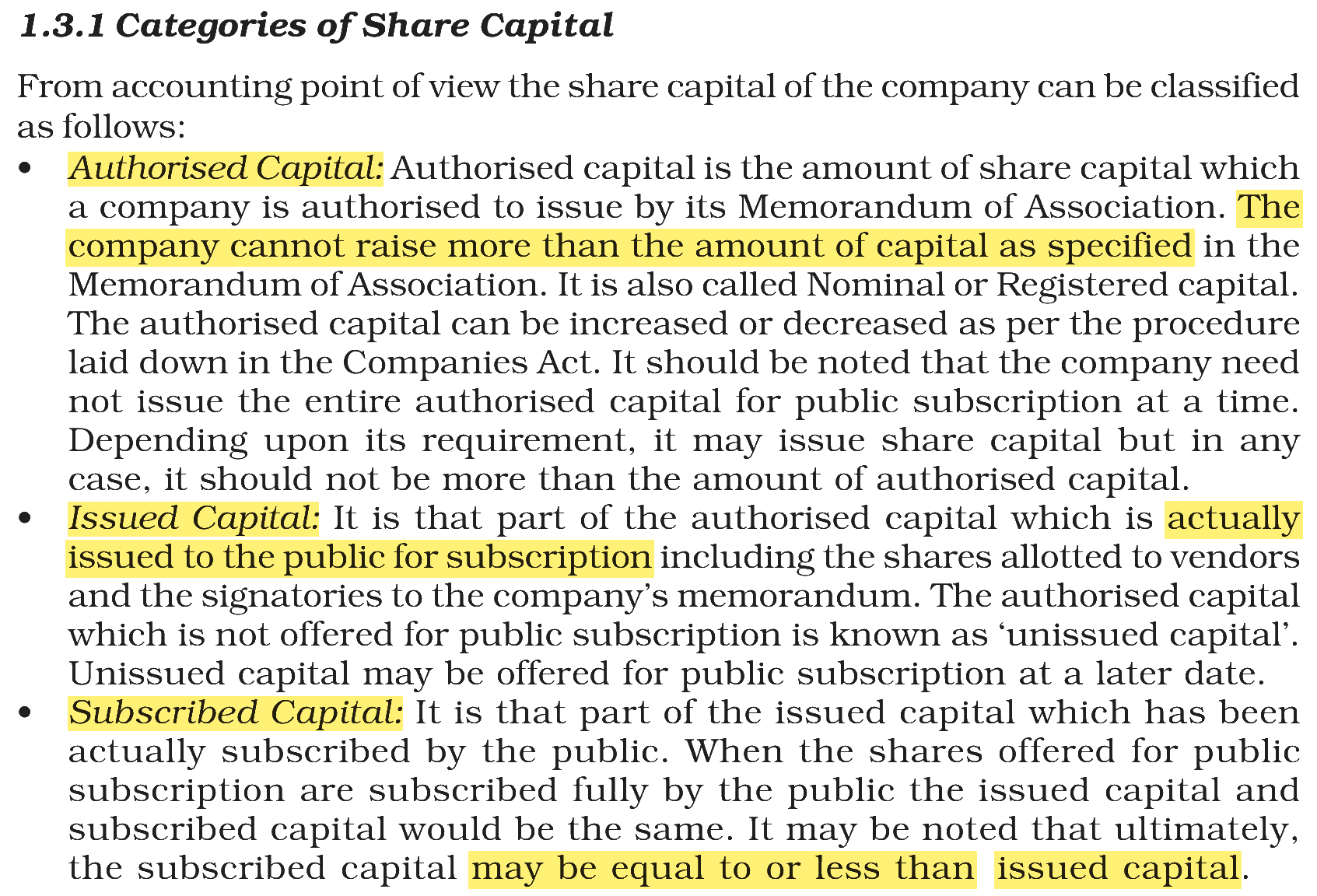
(A) Authorised Capital — this matches (II). It is the ceiling fixed by the Memorandum of Association; the company cannot raise more than this amount unless the Memorandum is altered.
(B) Issued Capital — this matches (III). It is the part of authorised capital actually offered to the public for subscription.
(C) Subscribed Capital — this matches (IV). The public may take up all the shares offered or fewer, so subscribed capital can equal issued capital or fall short of it, never exceed it.
(D) Reserve Capital — this matches (I). It is uncalled capital that can be called only when the company is wound up, so it is there for the creditors at that time.
NCERT (2026-27 edition):
NCERT (2026-27 edition):
|