
Restriction enzymes belong to a larger class of enzymes called nucleases. These are of two kinds; exonucleases and endonucleases. Exonucleases remove nucleotides from the ends of the DNA whereas, endonucleases make cuts at specific positions within the DNA. Each restriction endonuclease functions by ‘inspecting’ the length of a DNA sequence. Once it finds its specific recognition sequence, it will bind to the DNA and cut each of the two strands of the double helix at specific points in their sugar-phosphate backbones. Each restriction endonuclease recognises a specific nucleotide sequences in the DNA.
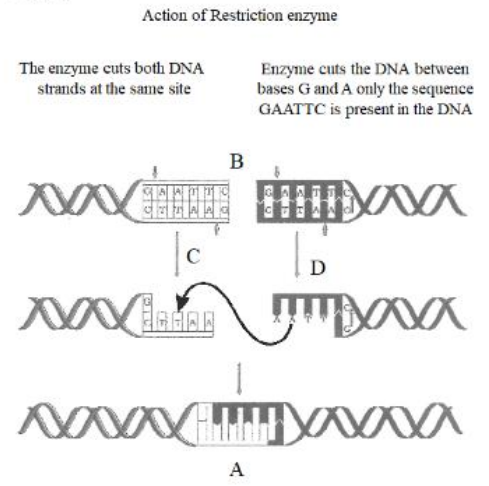
Identify the correct sequence for the process shown above:
A. Recombinant DNA
B. Foreign DNA and Vector DNA
C. EcoRI
D. Sticky Ends
Choose the correct answer from the options given below:
Answer & explanation
Correct answer: option 2
The correct answer is Option (2) → B, C, D, A
In the figure, EcoRI first acts on the foreign DNA and vector DNA (B); the enzyme is EcoRI (C), which cuts both at GAATTC and leaves sticky ends (D); the sticky ends of the two DNAs join to give recombinant DNA (A).
Note: The passage is taken from NCERT. NTA has put lines of the NCERT text together to make it. Most CUET (UG) questions come straight from NCERT, so study the book line by line, including figures and their titles.