
Question is based on following passage:
Methyl nitrile is hydrolysed to carboxylic acid in the presence of \(H^+\) or \(OH^-\) as catalyst. An intermediate compound [A] is formed during this reaction.
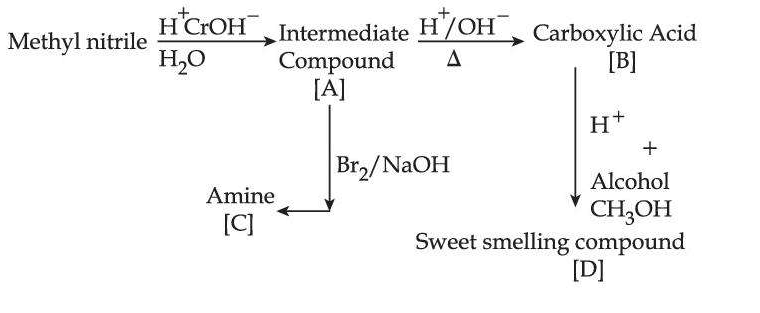
The sweet smelling compound [D] is:
Answer & explanation
Correct answer: option 4
The correct answer is Option (4) → Ester
[B] is ethanoic acid. Heating it with an alcohol (\( \ce{CH3OH} \)) in the presence of a mineral acid is esterification:
\( \displaystyle \ce{CH3COOH + CH3OH } \overset{\ce{H+}}{\rightleftharpoons} \ce{CH3COOCH3 + H2O} \)
The product, methyl ethanoate, is an ester; esters have a pleasant, sweet (fruity) smell, so [D] is the sweet-smelling compound.
Why the other options are incorrect
Option (1) Acid anhydride — Incorrect. An anhydride forms when two acid molecules lose water on heating with \( \ce{P2O5} \) or conc. \( \ce{H2SO4} \); no alcohol takes part.
Option (2) Acyl halide — Incorrect. Acyl chlorides are made from acids with \( \ce{PCl5} \), \( \ce{PCl3} \) or \( \ce{SOCl2} \), not with an alcohol; they have a pungent smell.
Option (3) Aldehyde — Incorrect. An acid does not give an aldehyde with an alcohol; aldehydes come from oxidation of primary alcohols or reduction of acid derivatives.
NCERT (2026-27 edition):
Esterification
