
Which one of the following events is true about the lac operon in the absence of an inducer?
Answer & explanation
Correct answer: option 2
The correct answer is Option (2) – Repressor binds to the operator and prevents RNA polymerase from transcribing the operon
The lac operon consists of one regulatory gene (the i gene – here the term i does not refer to inducer, rather it is derived from the word inhibitor) and three structural genes (z, y, and a). The i gene codes for the repressor of the lac operon. The z gene codes for beta-galactosidase ( β-gal), which is primarily responsible for the hydrolysis of the disaccharide, lactose into its monomeric units, galactose and glucose. The y gene codes for permease, which increases permeability of the cell to β-galactosides. The a gene encodes a transacetylase. Hence, all the three gene products in lac operon are required for metabolism of lactose.
Lactose is the substrate for the enzyme beta-galactosidase and it regulates switching on and off of the operon. Hence, it is termed as inducer.
The repressor of the operon is synthesised (all-the-time – constitutively) from the i gene. The repressor protein binds to the operator region of the operon and prevents RNA polymerase from transcribing the operon. In the presence of an inducer, such as lactose or allolactose, the repressor is inactivated by interaction with the inducer. This allows RNA polymerase access to the promoter and transcription proceeds.
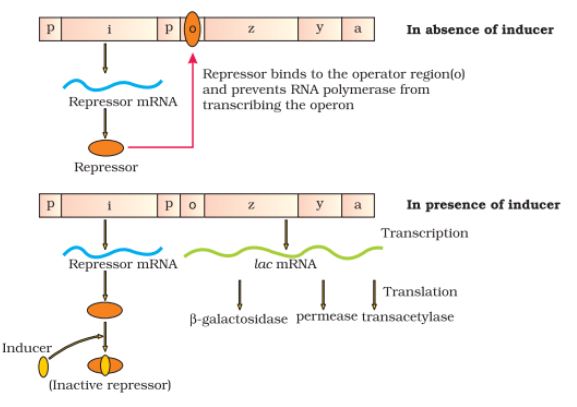
Lac Operon