
CUETMOCK
  • Pricing
  • Mentors
Log inStart freeStart free mocks→

First test, then trust

Try a free CUET mock test.

Join 5,00,000+ students who rehearsed exam day on the exact NTA screen before sitting CUET. On the web and on Android.

Start free mocks →Get the Android app
CUETMOCK

India's #1 CUET Mock Test Platform. Original NCERT-based questions on the exact NTA exam screen — trusted by 5,00,000+ students since CUET 2022.

Get it onGoogle PlayScan to download the CUETMOCK app

Mock tests

  • CUET mock test series
  • Commerce mocks
  • Humanities (Arts) mocks
  • Science mocks
  • Languages & GAT mocks
  • Free practice questions
  • Pricing

Resources

  • CUET exam guide
  • CUET syllabus
  • Universities accepting CUET
  • Expert blogs
  • News & notifications
  • Webinars & counselling
  • CUET score calculator
  • How we estimate your rank
  • FAQs

Company

  • About us
  • Our leadership & team
  • Our toppers
  • Mentors
  • For schools
  • Contact us
  • Terms
  • Privacy
  • Refund policy

Talk to us

+91 7696 6630 56info@cuetmock.comWhatsApp us

Our other platforms

  • JEE Mock — For IIT-JEE aspirants
  • NEET Mock — For NEET aspirants

Newsletter

Exam updates, study material and offers — no spam.

© 2026 NYC Ventures Pvt. Ltd.

701-702, Royal Business Park, Zirakpur, Punjab - 140603

  • Terms of use
  • Privacy policy
  • Refund policy
  • Contact us

iCUETMOCK is an independent preparation platform, not affiliated with the National Testing Agency (NTA). Always check exam details on the official NTA website.

  • Home
  • Mock tests
  • CUET guide
  • Pricing
  • Log in
Home/Practice questions/Chemistry
ChemistryOrganic: Alcohols, Phenols and Ethers

Which of the following can be used to distinguish between the two com…

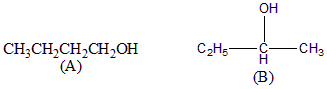
Which of the following can be used to distinguish between the two compounds (A) and (B) given below?
Answer & explanation+

Correct answer: option 4

The correct answer is Option (4) → All of them

(A) \( \ce{CH3CH2CH2CH2OH} \) is butan-1-ol, a primary alcohol; (B) \( \ce{CH3CH2CH(OH)CH3} \) is butan-2-ol, a secondary alcohol. A test distinguishes them when one gives a visible result and the other does not. Each of the three tests does this.

  • Oxidation with PCC followed by Tollens’ test — PCC oxidises (A) to the aldehyde butanal and (B) to the ketone butan-2-one:

        \( \displaystyle \ce{CH3CH2CH2CH2OH} \xrightarrow{\text{PCC}} \ce{CH3CH2CH2CHO} \)

        \( \displaystyle \ce{CH3CH2CH(OH)CH3} \xrightarrow{\text{PCC}} \ce{CH3CH2COCH3} \)

    On warming with Tollens’ reagent, butanal is oxidised and gives a silver mirror; butan-2-one, a ketone, gives none.

        \( \displaystyle \ce{CH3CH2CH2CHO + 2[Ag(NH3)2]^+ + 3OH^- -> CH3CH2CH2COO^- + 2Ag + 2H2O + 4NH3} \)

  • Lucas reagent (conc. \( \ce{HCl} \) + \( \ce{ZnCl2} \)) — the alkyl chloride formed is insoluble and makes the solution turbid. (B), a secondary alcohol, reacts faster and turns turbid on standing; (A), a primary alcohol, gives no turbidity at room temperature.

        \( \displaystyle \ce{CH3CH2CH(OH)CH3 + HCl} \xrightarrow{\ce{ZnCl2}} \ce{CH3CH2CHClCH3 + H2O} \)

  • Iodoform test (I2/NaOH) — (B) has the \( \ce{CH3CH(OH)-} \) group, which the reagent oxidises to \( \ce{CH3CO-} \); this then gives a yellow precipitate of iodoform. (A) has no such group and gives no precipitate.

        \( \displaystyle \ce{CH3CH2CH(OH)CH3 + 4I2 + 6NaOH -> CHI3 v + CH3CH2COONa + 5NaI + 5H2O} \)

NCERT (2026-27 edition):
7.4.4 Chemical Reactions – “… A better reagent for oxidation of primary alcohols to aldehydes in good yield is pyridinium chlorochromate (PCC), a complex of chromium trioxide with pyridine and HCl.”

8.2.1 Preparation of Aldehydes and Ketones – “Aldehydes and ketones are generally prepared by oxidation of primary and secondary alcohols, respectively (Unit 7, Class XII).”

8.4 Chemical Reactions – “The mild oxidising agents given below are used to distinguish aldehydes from ketones: (i) Tollens’ test: On warming an aldehyde with freshly prepared ammoniacal silver nitrate solution (Tollens’ reagent), a bright silver mirror is produced due to the formation of silver metal.”

7.4.4 Chemical Reactions – “The difference in reactivity of three classes of alcohols with HCl distinguishes them from one another (Lucas test). Alcohols are soluble in Lucas reagent (conc. HCl and ZnCl2) while their halides are immiscible and produce turbidity in solution. … Primary alcohols do not produce turbidity at room temperature.”

8.4 Chemical Reactions – “Iodoform reaction with sodium hypoiodite is also used for detection of CH3CO group or CH3CH(OH) group which produces CH3CO group on oxidation.”

Advertisement

Practise more on Organic: Alcohols, Phenols and Ethers

Chapter-wise mocks on the real NTA exam screen, with solutions and your rank. Your first mocks are free.

Start free mocks →

Advertisement

Next questions

  1. Swabhiman ltd. purchased assets of the book value of Rs. 1,98,000 from Alok Ltd. It was agreed that purchase consideration should be paid b…Accountancy Part A · Issue and Redemption of Debentures
  2. You are given a transformer that has 800 turns on its primary coil and 64 turns on its secondary coil. A voltage of 220 V is applied to the…Physics · Alternating Current
  3. The following is not a function of Financial Market:Business Studies · Financial Markets
  4. Which of the following is true of official reserve transactions?Economics · Macro Economics: Open Economy Macro Economics
  5. 'कूलहीन' में प्रत्यय होगा:Hindi · Comprehension - (Poetry / Literary)
  6. Which Article confers power to the Parliament to amend the Constitution?Legal Studies · Judiciary
  7. What is the discount per debenture?Accountancy · Issue and Redemption of Debentures
  8. One number is selected at random from first two hundred positive integers. The probability that it is divisible by 6 or 8, is equal toMaths. Section B1 · Probability
  9. Which one of the following is not the part of atmosphere?General Aptitude Test · General Knowledge
  10. What is the compound interest for 1 year on a sum of Rs. 18000 at the annual rate of 20 percent per annum compounding half yearly?General Aptitude Test · Numerical Ability