
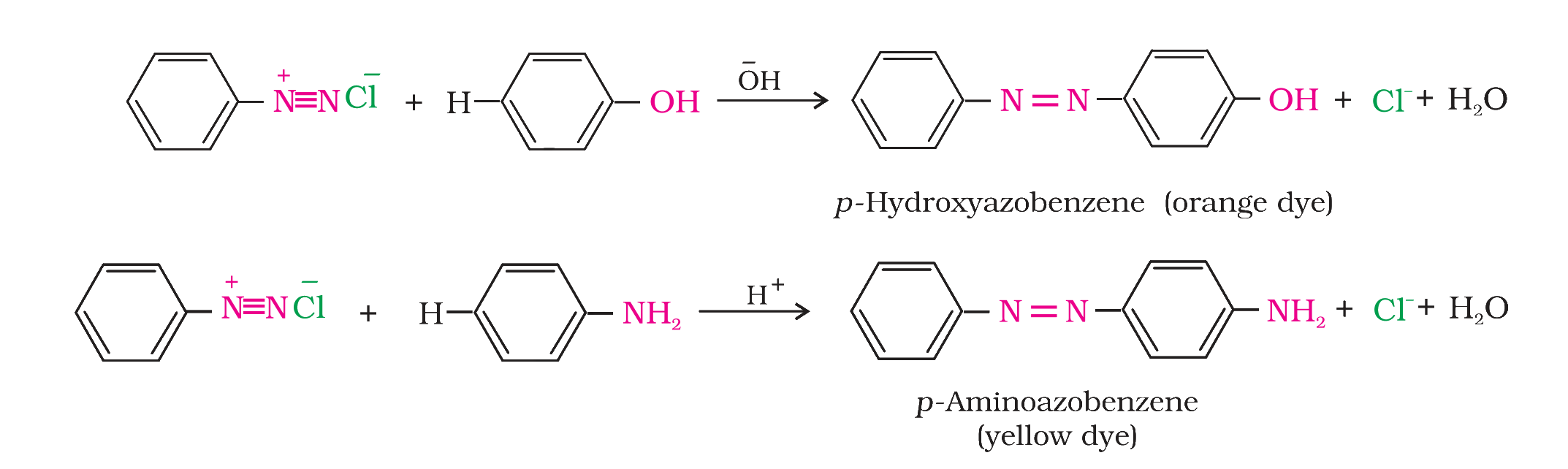
The figure shows two coupling reactions of benzenediazonium chloride.
Which species acts as the electrophile in these reactions?
Answer & explanation
Correct answer: option 4
The correct answer is Option (4) → The benzenediazonium ion
In the scheme the ring H of phenol and of aniline (drawn as H–C6H4–) is replaced by the C6H5–N=N– group. Coupling is an electrophilic substitution: an electron-poor species attacks the electron-rich ring and takes the place of an H atom.
The benzenediazonium ion, \( \ce{C6H5N2+} \), carries a positive charge and bonds to the para carbon of the phenol or aniline ring, so it is the electrophile. The diazo group is kept in the product as the –N=N– link.
Why the other options are incorrect
Option (1) Phenol or aniline — Incorrect. Their rings are the ones attacked; the –OH and –NH2 groups make them electron-rich, so they are the substrates, not the electrophile.
Option (2) The chloride ion — Incorrect. Cl− is a negative ion; it is set free unchanged as a product.
Option (3) The hydroxide ion — Incorrect. OH− provides the alkaline medium for the phenol reaction. It is a negative ion, an electron-pair donor, and it does not bond to the ring.
NCERT (2026-27 edition):
9.9 Chemical Reactions – “The azo products obtained have an extended conjugate system having both the aromatic rings joined through the –N=N– bond. These compounds are often coloured and are used as dyes. Benzene diazonium chloride reacts with phenol in which the phenol molecule at its para position is coupled with the diazonium salt to form p-hydroxyazobenzene. This type of reaction is known as coupling reaction. Similarly the reaction of diazonium salt with aniline yields p-aminoazobenzene. This is an example of electrophilic substitution reaction.”
Coupling reactions of benzenediazonium chloride