
The amino group is ortho, para directing and a powerful activating group, so aryl amines undergo the typical electrophilic substitution reactions readily. In fact, the rate of these reactions is so great that in certain cases poly-substitution, rather than mono-substitution, occurs even under mild conditions. If the reaction has to be stopped at the mono-substitution stage, the activating effect of the –NH2 group has to be controlled.
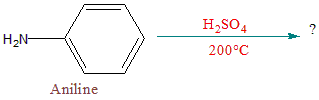
Identify the product of the given reaction.
Answer & explanation
Correct answer: option 1
The correct answer is Option (1) → p-Aminobenzenesulphonic acid
Sulphonation of aniline takes place in two stages:
With concentrated sulphuric acid: the basic –NH2 group takes up a proton and the salt anilinium hydrogensulphate is formed.
\( \displaystyle \ce{C6H5NH2 + H2SO4 -> C6H5NH3^+HSO4^-} \)
On heating at 453–473 K (200°C = 473 K): the salt gives the –SO3H group at the para position.
\( \displaystyle \ce{C6H5NH3^+HSO4^-} \xrightarrow{453-473\,\mathrm{K}} \ce{H2N-C6H4-SO3H + H2O} \)
The major product is p-aminobenzenesulphonic acid, commonly called sulphanilic acid.
Why the other options are incorrect
Option (2) o-Aminobenzenesulphonic acid — Incorrect. The para acid is the major product, not the ortho acid.
Option (3) m-Aminobenzenesulphonic acid — Incorrect. The –SO3H group ends up para to the amino group, not meta.
Option (4) Anilinium hydrogensulphate — Incorrect. It is the salt formed first; at 200°C it is converted into sulphanilic acid.
NCERT (2026-27 edition):
9.6 Chemical Reactions – “(c) Sulphonation: Aniline reacts with concentrated sulphuric acid to form anilinium hydrogensulphate which on heating with sulphuric acid at 453-473K produces p-aminobenzene sulphonic acid, commonly known as sulphanilic acid, as the major product.”