Match List-I with List-II
| List-I | List-II | ||
| (A) | Gaining Ratio | (I) | Average Profit X 100/Normal rate of return |
| (B) | Value of Goodwill | (II) | Old Ratio - New Ratio |
| (C) | Sacrificing Ratio | (III) | Super Profit X 100/Normal rate of return |
| (D) | Capitalised Value of average profit | (IV) | New Ratio - Old Ratio |
Choose the correct answer from the options given below:
Answer & explanation
Correct answer: option 2
The correct answer is Option (2) → (A) - (IV), (B) - (III), (C) - (II), (D) - (I)
Each item in List-I is worked out by a formula. Match them by asking what is taken away from what, and what is capitalised.
(A) Gaining Ratio — this matches (IV) New Ratio − Old Ratio. A gaining partner takes up more share, so his new share is larger than his old one.
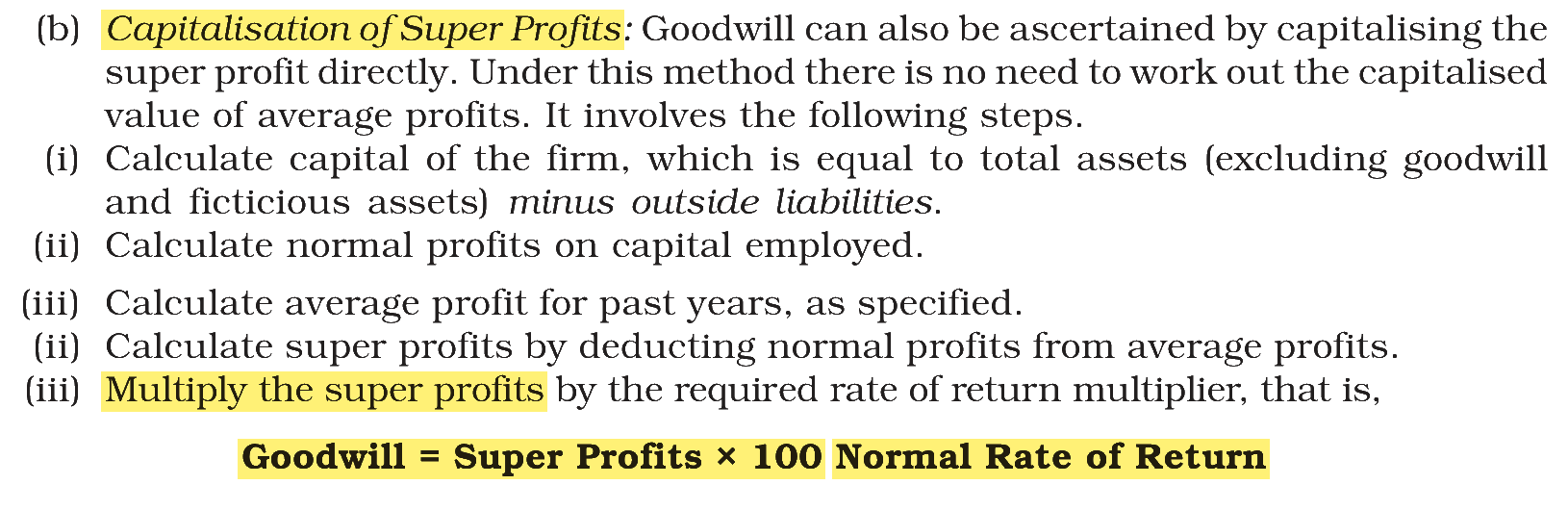
(B) Value of Goodwill — this matches (III) Super Profit × 100/Normal rate of return. Under the capitalisation of super profits method, goodwill is the super profit capitalised at the normal rate of return.
(C) Sacrificing Ratio — this matches (II) Old Ratio − New Ratio. A sacrificing partner gives up share, so his old share is the larger one.
(D) Capitalised Value of average profit — this matches (I) Average Profit × 100/Normal rate of return. It is the same capitalising step, applied to the average profit instead of the super profit. Goodwill under this method is the capitalised value less the firm’s capital (net assets).
Note: The NCERT book (2026-27) prints the super profits formula as “Goodwill = Super Profits × 100 Normal Rate of Return”, leaving out the division sign. It should read Super Profits × 100/Normal Rate of Return, as in item (III) of the question.
NCERT (2026-27 edition):
NCERT (2026-27 edition):
NCERT (2026-27 edition):
NCERT (2026-27 edition):
|