
CUETMOCK
  • Pricing
  • Mentors
Log inStart freeStart free mocks→

First test, then trust

Try a free CUET mock test.

Join 5,00,000+ students who rehearsed exam day on the exact NTA screen before sitting CUET. On the web and on Android.

Start free mocks →Get the Android app
CUETMOCK

India's #1 CUET Mock Test Platform. Original NCERT-based questions on the exact NTA exam screen — trusted by 5,00,000+ students since CUET 2022.

Get it onGoogle PlayScan to download the CUETMOCK app

Mock tests

  • CUET mock test series
  • Commerce mocks
  • Humanities (Arts) mocks
  • Science mocks
  • Languages & GAT mocks
  • Free practice questions
  • Pricing

Resources

  • CUET exam guide
  • CUET syllabus
  • Universities accepting CUET
  • Expert blogs
  • News & notifications
  • Webinars & counselling
  • CUET score calculator
  • How we estimate your rank
  • FAQs

Company

  • About us
  • Our leadership & team
  • Our toppers
  • Mentors
  • For schools
  • Contact us
  • Terms
  • Privacy
  • Refund policy

Talk to us

+91 7696 6630 56info@cuetmock.comWhatsApp us

Our other platforms

  • JEE Mock — For IIT-JEE aspirants
  • NEET Mock — For NEET aspirants

Newsletter

Exam updates, study material and offers — no spam.

© 2026 NYC Ventures Pvt. Ltd.

701-702, Royal Business Park, Zirakpur, Punjab - 140603

  • Terms of use
  • Privacy policy
  • Refund policy
  • Contact us

iCUETMOCK is an independent preparation platform, not affiliated with the National Testing Agency (NTA). Always check exam details on the official NTA website.

  • Home
  • Mock tests
  • CUET guide
  • Pricing
  • Log in
Home/Practice questions/Chemistry
ChemistryOrganic: Aldehydes, Ketones and Carboxylic Acids

Which of the following compounds will exhibit slowest rate of reactio…

Comprehension:

Nucleophilic Addition Reactions

Organic compounds containing carbon-oxygen double bond (>C=O ) are called carbonyl group, which is one of the most important functional group in organic chemistry. In aldehydes, the carbonyl group is bonded to a carbon and hydrogen while in ketones, it is bonded to two carbon atoms.The carbonyl compounds in which carbon of carbonyl group is bonded to carbon or hydrogen and oxygen of hydroxyl moiety (-OH) are known as carboxylic acids , while in compounds where carbon is attached to carbon or hydrogen and nitrogen of -NH2 moiety or to halogens are called amides and acyl halides respectively. Aldehydes, ketones, and carboxylic acids are widespread in plants and animal kingdom. They add fragrance and flavour to nature, for example, vanillin ( from vanilla bean), salicylaldehyde ( from meadow sweet ) and cinnamaldehyde ( cinnamon) have pleasant fragrances.

The carbonyl carbon atom is sp2-hybridised and forms three sigma ( σ ) bonds. The fourth valence electron of carbon remains in its p-orbital and forms a π-bond with oxygen by overlap with p-orbital of an oxygen. In addition , the oxygen atom also has two non bonding electron pairs. Thus, the carbonyl carbon and the three atoms attached to it lie in the same plane and the π-electron cloud is above and below this plane. The bond angles are approximately 120° and trigonal coplanar structure.

The carbon-oxygen double bond is polarised due to higher electronegativity of oxygen relative to carbon. Hence, the carbonyl carbon is an electrophilic (Lewis acid), and carbonyl oxygen , a nucleophilic (Lewis base) centre. Carbonyl compounds have substantial dipole moments and are more polar than ethers. Aldehyde and ketone can be prepared by oxidation of alcohols, dehydrogenation of alcohols, and ozonolysis of alkenes etc.

Which of the following compounds will exhibit slowest rate of reaction with HCN in the presence of NaOH?

Answer & explanation+

Correct answer: option 4

The correct answer is Option (4) → Acetophenone

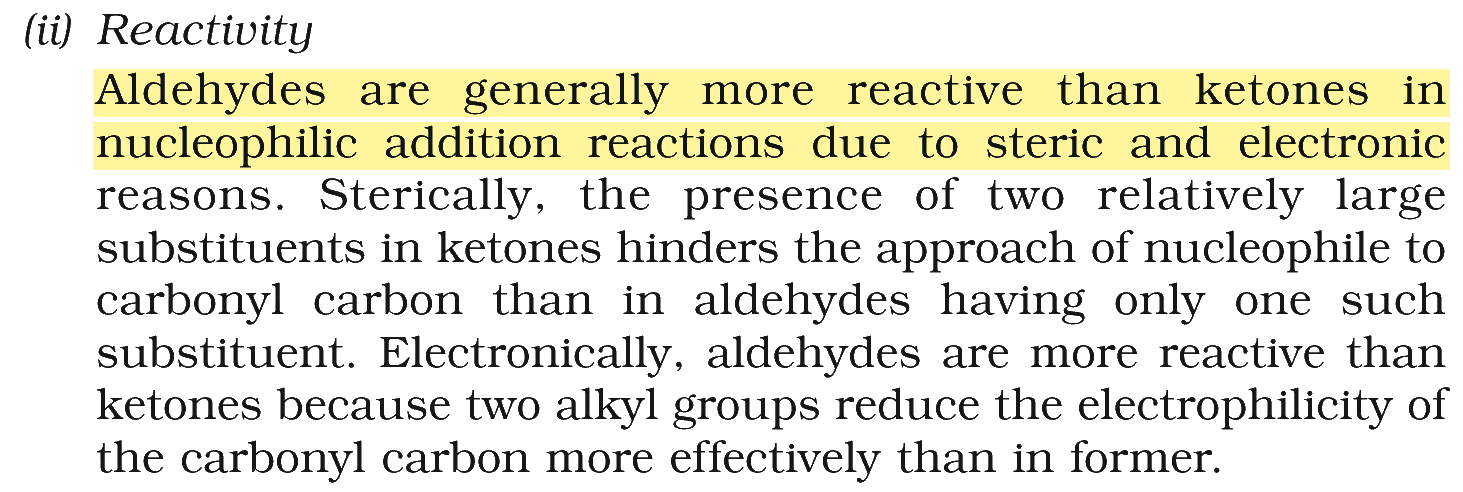
Addition of HCN is a nucleophilic addition: \( \ce{CN^{-}} \) (formed from HCN by the base) attacks the electrophilic carbonyl carbon. The reaction is faster when the carbonyl carbon is more positive and less crowded:

  • Substituents on the ring: an electron withdrawing group (–\( \ce{NO2} \)) makes the carbonyl carbon more positive and speeds up the addition; an electron releasing group (–\( \ce{CH3} \)) slows it down.

    \( \displaystyle \ce{R2C=O + HCN} \xrightarrow{\ce{OH^-}} \ce{R2C(OH)CN} \)

The rate order for the given compounds is:

    4-nitrobenzaldehyde > benzaldehyde > p-tolualdehyde > acetophenone

So acetophenone, the only ketone, reacts most slowly.

Why the other options are incorrect

  • Option (1) Benzaldehyde — Incorrect. An aldehyde, with only one group on the carbonyl carbon, so it is faster than any ketone.

  • Option (2) p-Tolualdehyde — Incorrect. The para –\( \ce{CH3} \) group slows it a little compared with benzaldehyde, but it is still an aldehyde and faster than acetophenone.

  • Option (3) 4-Nitrobenzaldehyde — Incorrect. The strongly electron withdrawing –\( \ce{NO2} \) group makes it the fastest of the four.

NCERT (2026-27 edition):
Reactivity
Textbook extract

Advertisement

Practise more on Organic: Aldehydes, Ketones and Carboxylic Acids

Chapter-wise mocks on the real NTA exam screen, with solutions and your rank. Your first mocks are free.

Start free mocks →

Advertisement

Next questions

  1. हर एक बच्चा क्या सपना देखता है?Hindi · अपठित गद्यांश (Comprehension - Prose)
  2. Which of the following is the characteristic feature of gymnosperms?Biology · Plant Kingdom
  3. The order of the following differential equations: (y') ^ 4 = log xMaths. Section A · Differential Equations
  4. Select the most appropriate synonym of the given word.BureaucratEnglish · Synonyms
  5. General solution of displaystyledy/dx+√((1-y^2)/(1-x^2))=0 is :Maths. Section B1 · Differential Equations
  6. The product of order and degree of the differential equation ≤ft((d^3y)/(dx^3))^2 + x^2y≤ft((d^2y)/(dx^3))^3 = 2x^5 is:Maths. Section B1 · Differential Equations
  7. Select the most appropriate option to fill in the blank. We ensure that you will get a _________ chauffeur with the right car for your day.English · Fill Blanks
  8. Fill in the blanks in the given sentences in List-I with the verbs given in List-II:- List-I (Sentences) List-II (Verbs) (A) Without the __…English · Grammar: Verb
  9. Function of rectifier is –Physics · Semiconductors and Electronic Devices
  10. A historian reads the Manusmriti's list of the means by which men could acquire wealth. Which of the following would she NOT find in that l…History · Ancient India: Kinship, Caste and Class