
Read the passage given below and answer the following question.
Evolution by natural selection, in a true sense, would have started when cellular forms of life with differences in metabolic capability originated on earth. The essence of Darwinian theory about evolution is natural selection. The rate of appearance of new forms is linked to the life cycle or the life span. Microbes that divide fast have the ability to multiply and become millions of individuals within hours. A colony of bacteria (say A) growing on a given medium has built-in variation in terms of ability to utilise a feed component. A change in the medium composition would bring out only that part of the population (say B) that can survive under the new conditions. In due course of time this variant population outgrows the others and appears as new species. This would happen within days. For the same thing to happen in a fish or fowl would take millions of years as life spans of these animals are in years. Here we say that fitness of B is better than that of A under the new conditions. Nature selects for fitness.
Choose the correct statements about the mechanism of evolution from the following:
A. Microbial experiments show that pre-existing advantageous mutations, when selected, will result in observation of new phenotypes.
B. Variation due to recombination during gametogenesis can result in changed frequency of genes and alleles in future generations.
C. In stabilisation, more individuals acquire peripheral character value at both ends of the distribution curve.
D. In directional change, more individuals acquire value other than the mean character value.
Choose the correct answer from the options given below:
Answer & explanation
Correct answer: option 4
The correct answer is Option (4) → A, B and D only
Variation in a population comes from mutation, recombination, gene flow and genetic drift. Natural selection then acts on this variation in three ways, which differ in where the individuals of the next generation crowd on the distribution curve.
A. Microbial experiments show that pre-existing advantageous mutations, when selected, will result in observation of new phenotypes. — True. Over a few generations this would lead to speciation.
B. Variation due to recombination during gametogenesis can result in changed frequency of genes and alleles in future generations. — True. Recombination is one of the sources of variation, along with mutation, gene flow and genetic drift, that change gene and allele frequencies.
C. In stabilisation, more individuals acquire peripheral character value at both ends of the distribution curve. — False. This describes disruption, where two peaks form. In stabilisation, more individuals acquire the mean character value and the peak gets higher and narrower.
D. In directional change, more individuals acquire value other than the mean character value. — True. The peak of the curve shifts to one side.
NCERT Extract:
Hardy-Weinberg Principle – “… Microbial experiments show that pre-existing advantageous mutations when selected will result in observation of new phenotypes. Over few generations, this would result in Speciation. … A critical analysis makes us believe that variation due to mutation or variation due to recombination during gametogenesis, or due to gene flow or genetic drift results in changed frequency of genes and alleles in future generation. Coupled to enhance reproductive success, natural selection makes it look like different population. Natural selection can lead to stabilisation (in which more individuals acquire mean character value), directional change (more individuals acquire value other than the mean character value) or disruption (more individuals acquire peripheral character value at both ends of the distribution curve) (Figure 6.8).”
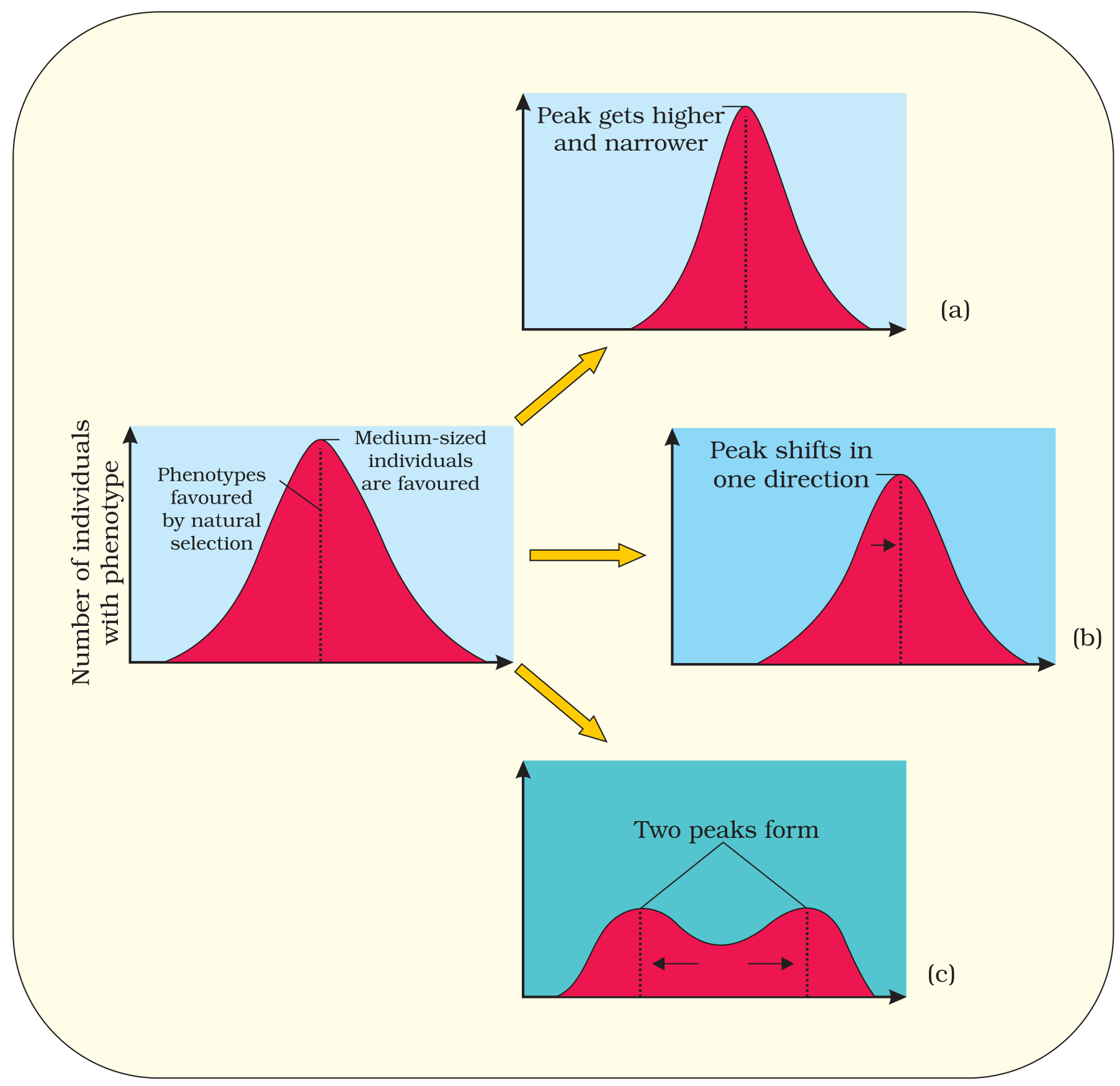
Figure 6.8 Diagrammatic representation of the operation of natural selection on different traits : (a) Stabilising (b) Directional and (c) Disruptive