Match List-I (reagent reacting with an alkyl halide, R–X) with List-II (class of the main product).
| List-I (Reagent) | List-II (Class of main product) |
|---|---|
| (A) R′O– | (I) Isonitrile |
| (B) R′COO– | (II) Ester |
| (C) NH3 | (III) Primary amine |
| (D) AgCN | (IV) Ether |
Choose the correct answer from the options given below:
Answer & explanation
Correct answer: option 1
The correct answer is Option (1) → A-IV, B-II, C-III, D-I
In nucleophilic substitution, the nucleophile attacks the carbon bonded to the halogen and the halogen leaves as halide ion. The atom through which the nucleophile links to carbon decides the class of the product.
(A) R′O– — This matches (IV) Ether. The alkoxide oxygen bonds to R, giving R–O–R′:
\( \displaystyle \ce{R-X + R'O^- -> R-O-R' + X^-} \)
(B) R′COO– — This matches (II) Ester. The carboxylate oxygen bonds to R, giving the ester R′COOR:
\( \displaystyle \ce{R-X + R'COO^- -> R'COOR + X^-} \)
(C) NH3 — This matches (III) Primary amine. The nitrogen of ammonia bonds to R, and RNH2 is formed:
\( \displaystyle \ce{R-X + NH3 -> R-NH2 + HX} \)
(D) AgCN — This matches (I) Isonitrile. Cyanide is an ambident nucleophile. AgCN is mainly covalent, so the nitrogen is free to donate its electron pair, and the isocyanide R–NC is the main product:
\( \displaystyle \ce{R-X + AgCN -> R-NC + AgX} \)
NCERT (2026-27 edition):
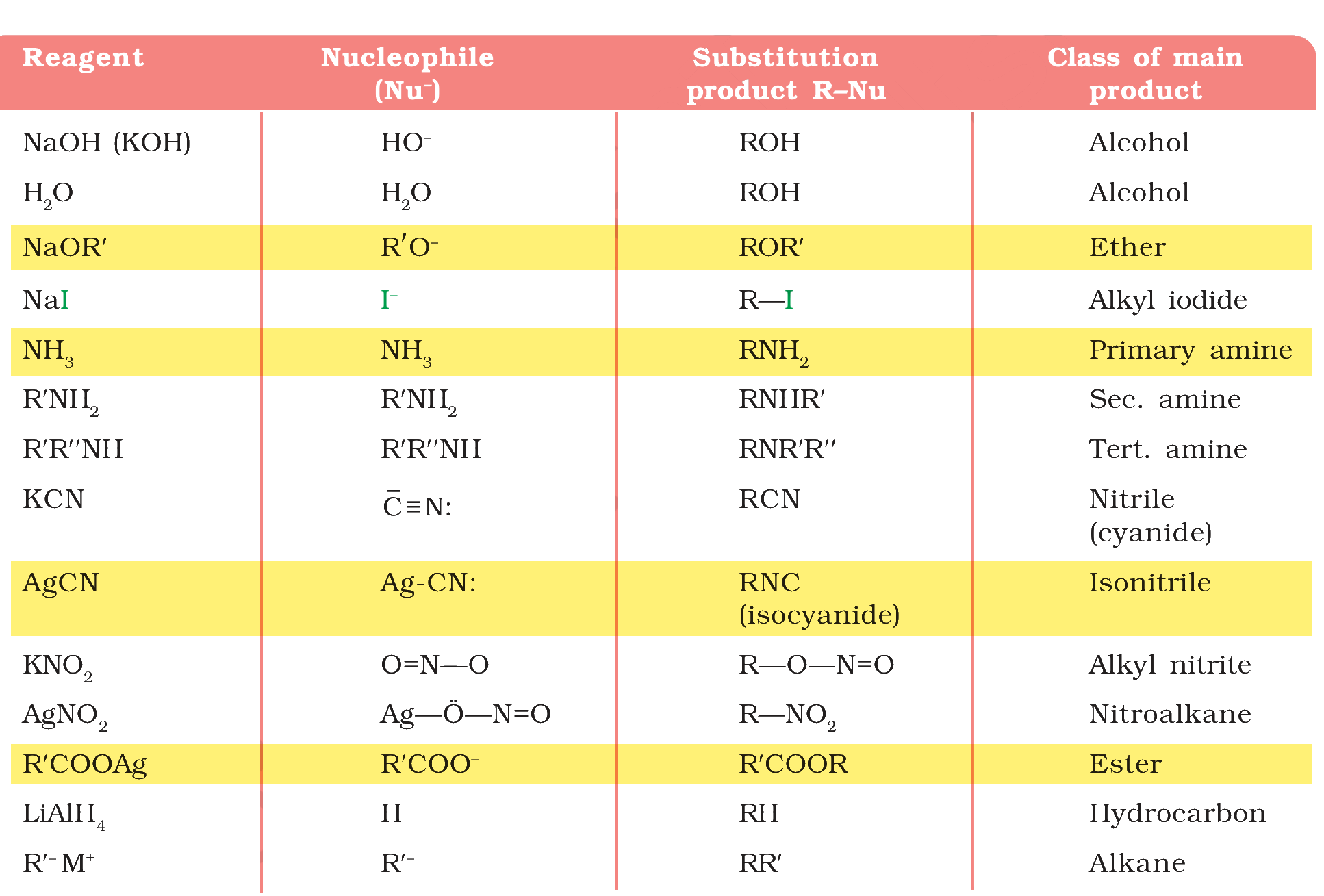
6.7.1 Reactions of Haloalkanes – “…The products formed by the reaction of haloalkanes with some common nucleophiles are given in Table 6.4.”
“…However, AgCN is mainly covalent in nature and nitrogen is free to donate electron pair forming isocyanide as the main product.”
Table 6.4: Nucleophilic Substitution of Alkyl Halides (R–X)