
CUETMOCK
  • Pricing
  • Mentors
Log inStart freeStart free mocks→

First test, then trust

Try a free CUET mock test.

Join 5,00,000+ students who rehearsed exam day on the exact NTA screen before sitting CUET. On the web and on Android.

Start free mocks →Get the Android app
CUETMOCK

India's #1 CUET Mock Test Platform. Original NCERT-based questions on the exact NTA exam screen — trusted by 5,00,000+ students since CUET 2022.

Get it onGoogle PlayScan to download the CUETMOCK app

Mock tests

  • CUET mock test series
  • Commerce mocks
  • Humanities (Arts) mocks
  • Science mocks
  • Languages & GAT mocks
  • Free practice questions
  • Pricing

Resources

  • CUET exam guide
  • CUET syllabus
  • Universities accepting CUET
  • Expert blogs
  • News & notifications
  • Webinars & counselling
  • CUET score calculator
  • How we estimate your rank
  • FAQs

Company

  • About us
  • Our leadership & team
  • Our toppers
  • Mentors
  • For schools
  • Contact us
  • Terms
  • Privacy
  • Refund policy

Talk to us

+91 7696 6630 56info@cuetmock.comWhatsApp us

Our other platforms

  • JEE Mock — For IIT-JEE aspirants
  • NEET Mock — For NEET aspirants

Newsletter

Exam updates, study material and offers — no spam.

© 2026 NYC Ventures Pvt. Ltd.

701-702, Royal Business Park, Zirakpur, Punjab - 140603

  • Terms of use
  • Privacy policy
  • Refund policy
  • Contact us

iCUETMOCK is an independent preparation platform, not affiliated with the National Testing Agency (NTA). Always check exam details on the official NTA website.

  • Home
  • Mock tests
  • CUET guide
  • Pricing
  • Log in
Home/Practice questions/Chemistry
ChemistryOrganic: Aldehydes, Ketones and Carboxylic Acids

What are the products when acetic acid reacts with PCl3?

What are the products when acetic acid reacts with PCl3?

Answer & explanation+

Correct answer: option 1

The correct answer is Option (1) → Acetyl chloride + H3PO3

The –OH of a carboxylic acid is replaced by a chlorine atom with PCl3, giving an acyl chloride. Three molecules of acid react with one PCl3, and the three OH groups end up on phosphorus as phosphorous acid, H3PO3:

    \( \displaystyle \ce{3CH3COOH + PCl3 -> 3CH3COCl + H3PO3} \)

Why the other options are incorrect

Option (2) Acetyl chloride + POCl3 — Incorrect. POCl3 (with HCl) is the by-product with PCl5, not with PCl3.

Option (3) Acetic anhydride + H3PO3 — Incorrect. Acetic anhydride is made by heating the acid with a dehydrating agent such as P2O5 or H2SO4; PCl3 gives the acid chloride.

Option (4) Acetic anhydride + POCl3 — Incorrect. Neither product forms: the organic product is acetyl chloride, and POCl3 belongs to the PCl5 reaction.

NCERT (2026-27 edition):
3. Reactions with PCl5, PCl3 and SOCl2 – “The hydroxyl group of carboxylic acids, behaves like that of alcohols and is easily replaced by chlorine atom on treating with PCl5, PCl3 or SOCl2.”
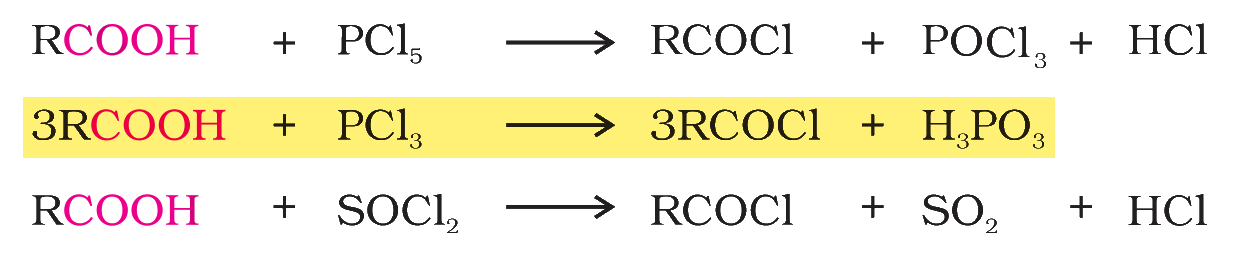
Textbook extract

Advertisement

Practise more on Organic: Aldehydes, Ketones and Carboxylic Acids

Chapter-wise mocks on the real NTA exam screen, with solutions and your rank. Your first mocks are free.

Start free mocks →

Advertisement

Next questions

  1. At what value of x is the function y = frac x ^ 2 2-3x attains its minimum value?Maths. Section A · Applications of Derivatives
  2. Match List-I with List-IIList-I(UN Secretaries-General)List-II(Contributions)(A)Ban Ki-moon(I)Issued a report, An Agenda for Peace(B)Kofi A…Political Science · Contemporary World Politics: International Organisations
  3. Match the following personalities of the Mughal era in List 1 with the description that suits them the most in List 2 correctly: List- 1 (P…History · Medieval India: Kings and Chronicles
  4. The domain of the function cos−1(2x − 1) isMaths. Section B1 · Inverse Trigonometric Functions
  5. The Western view of self holds clear dichotomies between self and other, and between man and nature. Between which other pair does it hold…Psychology · Self and Personality
  6. ΔABC ∼ ΔDEF such that AB = 9.1 cm and DE = 6.5 cm. If the perimeter of ΔDEF = 25 cm, then the perimeter of ΔABC is:General Aptitude Test · Quantitative Reasoning
  7. Match List-I with List-II List-IList-IIFunctionIncreasing on the interval(A) f(x) = -x^2 - 2x + 1 (I) (-∞, -1) (B) f(x) = x^2 + 1 (II) (1,…Applied Maths. Section B2 · Calculus
  8. Chemistry · Inorganic: D and F Block Elements
  9. From the following statement regarding the order of reaction, the statement that is not true isChemistry · Physical: Chemical Kinetics
  10. Tom left for his office in his car. He travelled 5 km towards the North and then 10 km towards the East. He then travelled 3 km towards the…General Aptitude Test · Verbal Reasoning