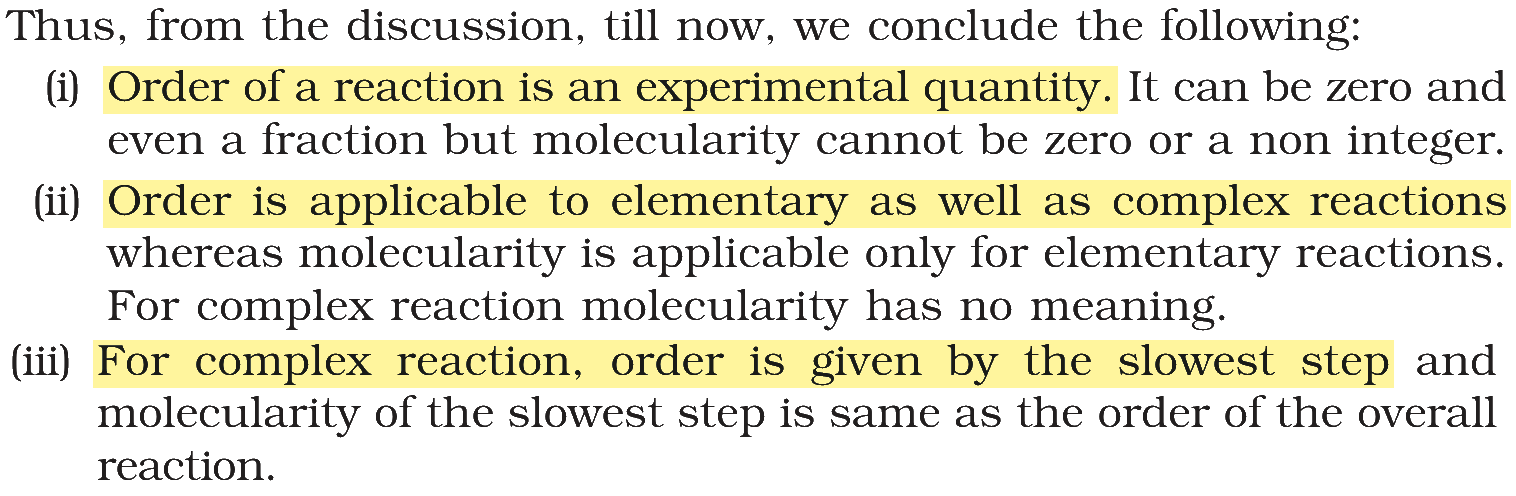
From the following statement regarding the order of reaction, the statement that is not true is
Answer & explanation
Correct answer: option 4
The correct answer is Option (4) → For complex reaction, order is given by the fastest step
A complex reaction takes place in a series of elementary steps, and its rate can be no faster than its slowest step, the rate determining step. So the order of a complex reaction is given by the slowest step, not the fastest one. For example, the decomposition of \( \ce{H2O2} \) catalysed by \( \ce{I-} \) is first order in each, because its slow step is:
\( \displaystyle \ce{H2O2 + I- -> H2O + IO-}\ \ (\text{slow}) \)
Option (1) Order of reaction is an experimental quantity — True about order. The order comes from the rate law found by experiment; it cannot be read from the coefficients of the balanced equation.
Option (2) The order of a reaction can be zero or even a fraction — True about order. The decomposition of ammonia on hot platinum is zero order, and orders such as 1/2 or 3/2 are known; only molecularity must be a whole number.
Option (3) Order of reaction is applicable to elementary reaction — True about order. Order applies to elementary as well as complex reactions, whereas molecularity applies only to elementary reactions.
Option (4) For complex reaction, order is given by the fastest step — Not true. The order of a complex reaction is given by the slowest step, the rate determining step.
NCERT (2026-27 edition):
Molecularity of a Reaction – …