Match List I with List II:
| List I | List II | ||
| (A) | Akbar Nama | (I) | Muhammad Kazim |
| (B) | Humayun Nama | (II) | Abdul Hamid Lahori |
| (C) | Alamgir Nama | (III) | Gulbadan Begum |
| (D) | Badshah Nama | (IV) | Abu'l Fazl |
Choose the correct answer from the options given below:
Answer & explanation
Correct answer: option 3
The correct answer is Option (3) → (A)-(IV), (B)-(III), (C)-(I), (D)-(II)
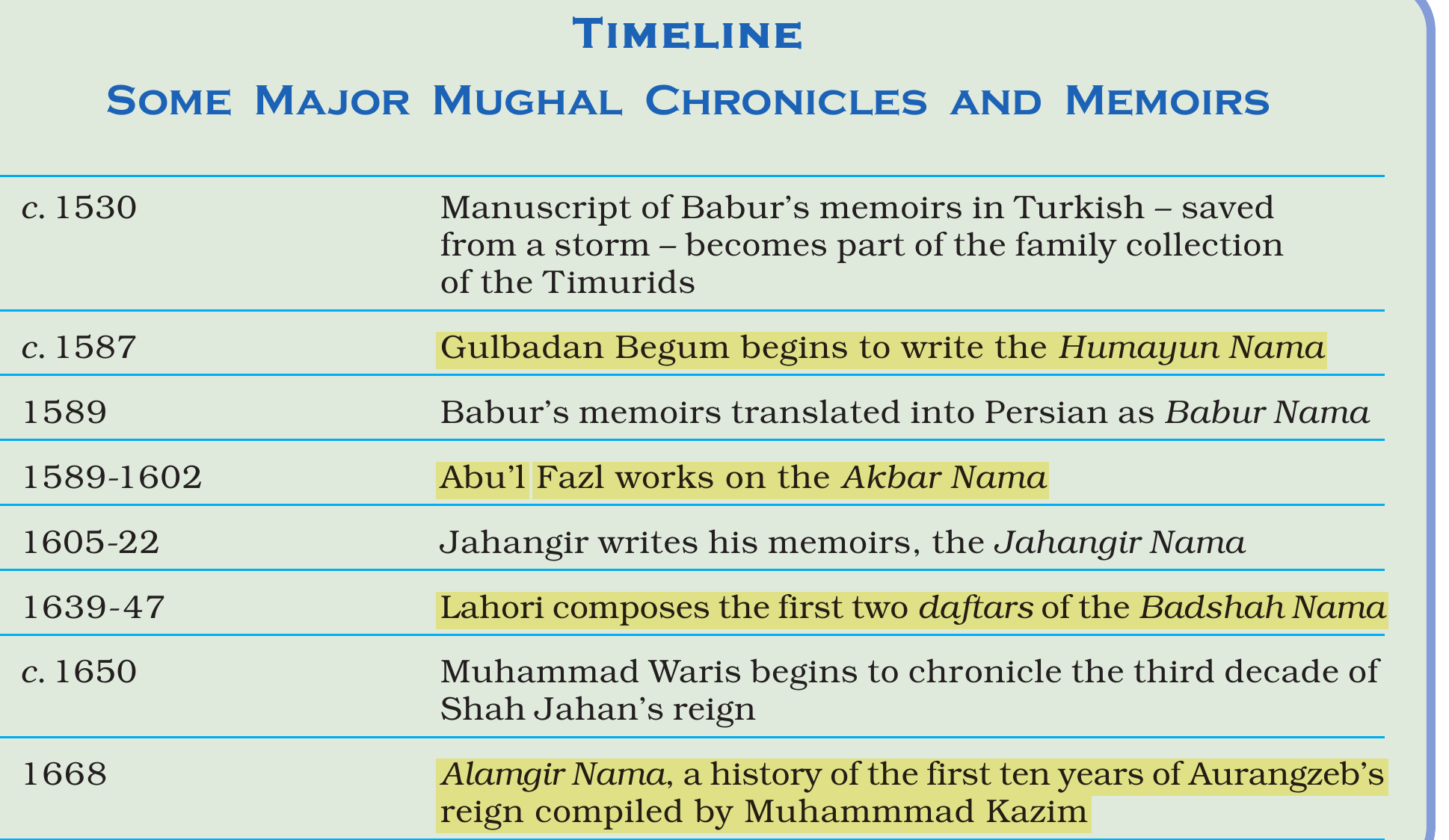
(A) Akbar Nama — this matches (IV) Abu’l Fazl. Abu’l Fazl worked on the Akbar Nama from 1589 to 1602.
(B) Humayun Nama — this matches (III) Gulbadan Begum. Babur’s daughter Gulbadan Begum began to write the Humayun Nama in about 1587.
(C) Alamgir Nama — this matches (I) Muhammad Kazim. This history of the first ten years of Aurangzeb’s reign was compiled by Muhammad Kazim in 1668.
(D) Badshah Nama — this matches (II) Abdul Hamid Lahori. Lahori composed the first two daftars of the Badshah Nama between 1639 and 1647.
Note 1: This question is taken from the chapter ‘Kings and Chronicles’ which was there in the pre-rationalised NCERT and has been deleted from subsequent editions of NCERT, including the NCERT book (2026-27).
Note 2: A same/similar question was asked in CUET (UG) in the papers below.
| 2026 | 2025 | 2024 | 2023 | 2022 |
| – | – | – | 13-06 S2 14-06 S3* 18-06 S1* | – |
* A similar question.
NCERT: Themes in Indian History Part II — Chapter 9: Kings and Chronicles (Pre-rationalised)
|