Which among the following compounds show metal excess defect due to anionic vacancy ?
Answer & explanation
Correct answer: option 2
The correct answer is Option (2) → NaCl
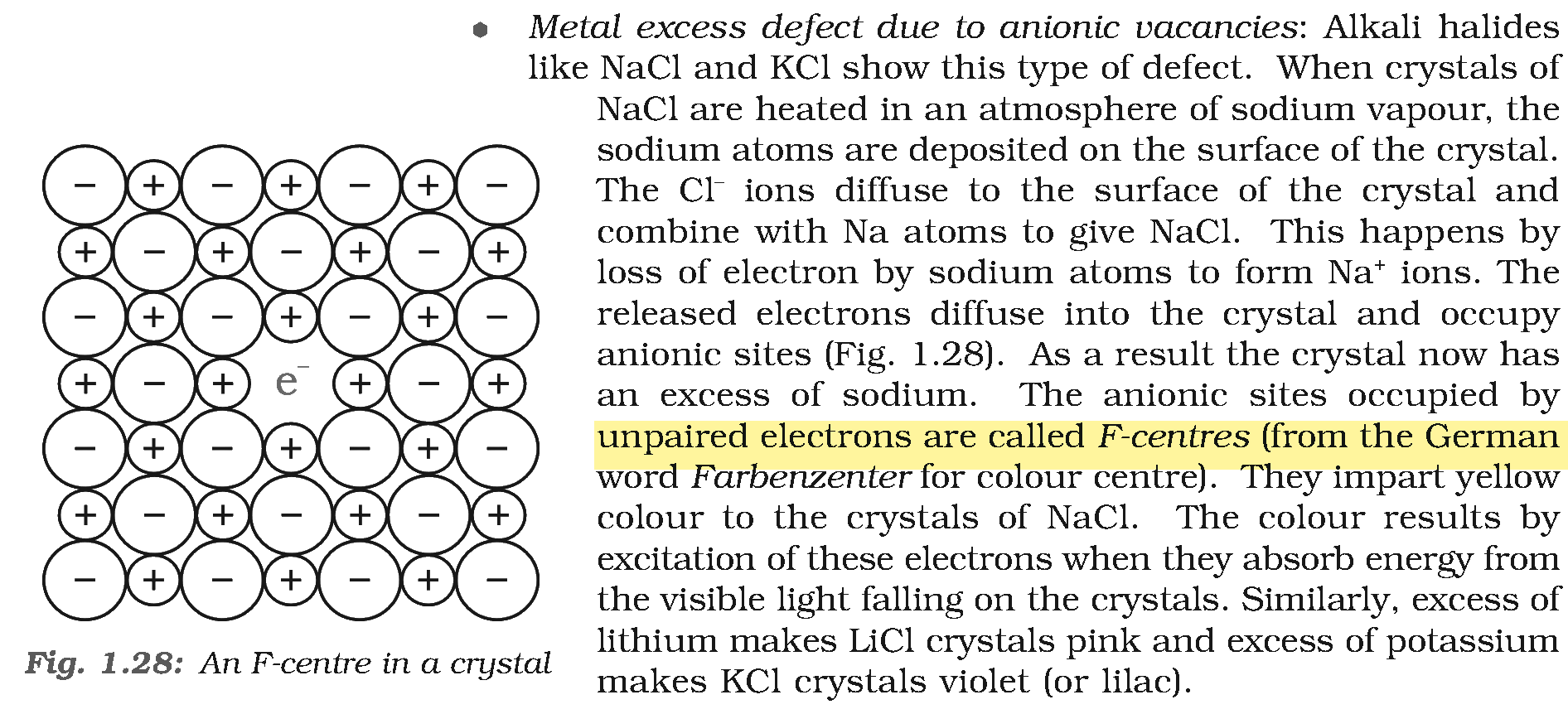
A metal excess defect due to anionic vacancies is shown by alkali halides: when NaCl is heated in sodium vapour, electrons occupy the vacant anionic sites, called F-centres, and the crystal turns yellow:
\( \displaystyle \ce{Na -> Na+ + e^-}\qquad \ce{Na+ + Cl^- -> NaCl} \)
So the compound is NaCl (LiCl turns pink and KCl violet in the same way).
Why the other options are incorrect
Option (1) ZnO — Incorrect. It shows metal excess due to extra cations in interstitial sites: on heating it loses oxygen and the extra \( \ce{Zn^2+} \) ions move into interstitial sites (and it turns yellow).
Option (3) FeO — Incorrect. It shows metal deficiency (\( \ce{Fe_{0.95}O} \)), with some \( \ce{Fe^2+} \) replaced by \( \ce{Fe^3+} \).
Option (4) CdO — Incorrect. It is not an alkali halide; the book names alkali halides such as NaCl and KCl for this defect.
Note: This question is from the pre-rationalised NCERT book (2022-23). The topic is not there in the latest NCERT book (2026-27), and it is also out of the CUET 2026 syllabus.
NCERT (Pre-rationalised edition, 2022-23):
Metal Excess Defect Due to Anionic Vacancies