CUETMOCK
  • Pricing
  • Mentors
Log inStart freeStart free mocks→

First test, then trust

Try a free CUET mock test.

Join 5,00,000+ students who rehearsed exam day on the exact NTA screen before sitting CUET. On the web and on Android.

Start free mocks →Get the Android app
CUETMOCK

India's #1 CUET Mock Test Platform. Original NCERT-based questions on the exact NTA exam screen — trusted by 5,00,000+ students since CUET 2022.

Get it onGoogle PlayScan to download the CUETMOCK app

Mock tests

  • CUET mock test series
  • Commerce mocks
  • Humanities (Arts) mocks
  • Science mocks
  • Languages & GAT mocks
  • Free practice questions
  • Pricing

Resources

  • CUET exam guide
  • CUET syllabus
  • Universities accepting CUET
  • Expert blogs
  • News & notifications
  • Webinars & counselling
  • CUET score calculator
  • How we estimate your rank
  • FAQs

Company

  • About us
  • Our leadership & team
  • Our toppers
  • Mentors
  • For schools
  • Contact us
  • Terms
  • Privacy
  • Refund policy

Talk to us

+91 7696 6630 56info@cuetmock.comWhatsApp us

Our other platforms

  • JEE Mock — For IIT-JEE aspirants
  • NEET Mock — For NEET aspirants

Newsletter

Exam updates, study material and offers — no spam.

© 2026 NYC Ventures Pvt. Ltd.

701-702, Royal Business Park, Zirakpur, Punjab - 140603

  • Terms of use
  • Privacy policy
  • Refund policy
  • Contact us

iCUETMOCK is an independent preparation platform, not affiliated with the National Testing Agency (NTA). Always check exam details on the official NTA website.

  • Home
  • Mock tests
  • CUET guide
  • Pricing
  • Log in
Home/Practice questions/History
HistoryAncient India: Kinship, Caste and Class

Match List-I with List-II:List-IMeaningsList-IITerms(A)Term used by t…

Match List-I with List-II:

List-I
Meanings
List-II
Terms
(A)Term used by the Sanskrit texts to designate families(I)Kula
(B)Tracing descent from father to son(II)Polygyny
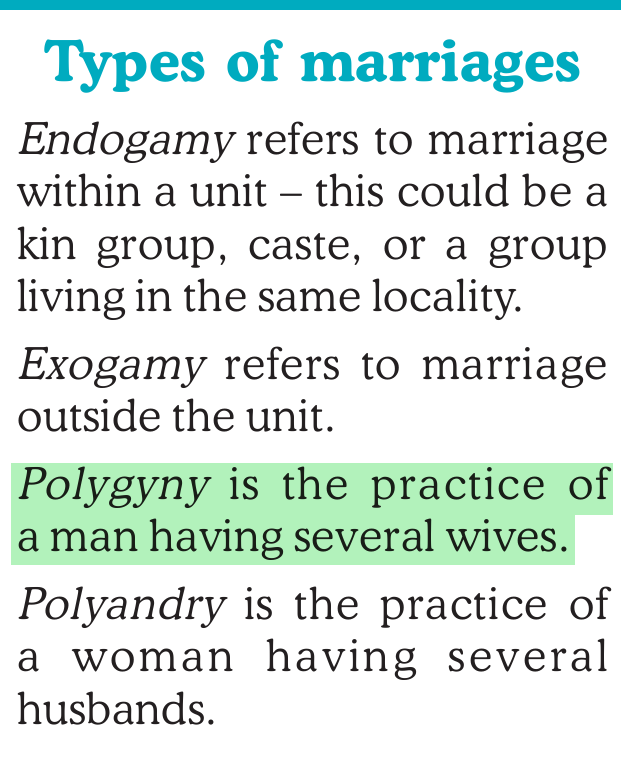
(C)The practice of a man having several wives(III)Patriliny
(D)The gift of a daughter in marriage(IV)Kanyadana

Choose the correct answer from the options given below:

Answer & explanation+

Correct answer: option 2

The correct answer is Option (2) → (A)-(I), (B)-(III), (C)-(II), (D)-(IV)

(A) Term used by the Sanskrit texts to designate families — this matches (I) Kula. Sanskrit texts use kula for families and jnati for the larger network of kinfolk.

(B) Tracing descent from father to son — this matches (III) Patriliny. Patriliny means tracing descent from father to son, grandson and so on.

(C) The practice of a man having several wives — this matches (II) Polygyny. Its opposite, a woman having several husbands, is polyandry.

(D) The gift of a daughter in marriage — this matches (IV) Kanyadana. It came to be seen as an important religious duty of the father.


NCERT (2026-27): “2.1 Finding out about families … Sanskrit texts use the term kula to designate families and jnati for the larger network of kinfolk. The term vamsha is used for lineage.

2.2 The ideal of patriliny … Patriliny means tracing descent from father to son, grandson and so on. Matriliny is the term used when descent is traced through the mother.

2.3 Rules of marriage … While sons were important for the continuity of the patrilineage, daughters were viewed rather differently within this framework. They had no claims to the resources of the household. At the same time, marrying them into families outside the kin was considered desirable. This system, called exogamy (literally, marrying outside), meant that the lives of young girls and women belonging to families that claimed high status were often carefully regulated to ensure that they were married at the ‘right’ time and to the ‘right’ person. This gave rise to the belief that kanyadana or the gift of a daughter in marriage was an important religious duty of the father.…”

NCERT extract

Advertisement

Practise more on Ancient India: Kinship, Caste and Class

Chapter-wise mocks on the real NTA exam screen, with solutions and your rank. Your first mocks are free.

Start free mocks →

Advertisement

Next questions

  1. The general solution of the differential equation displaystyledy/dx = 2^x + y is (C is an arbitrary constant)Maths. Section B1 · Differential Equations
  2. Which of the following reduce silver nitrate to silver?Chemistry · Inorganic: P Block Elements
  3. Select the option that represents the letters that, when sequentially placed from left to right in the blanks, will complete the letter ser…General Aptitude Test · General Ability
  4. Who was the originator of Ahmadiya Movement in British India?General Aptitude Test · General Knowledge
  5. A single discount equivalent to three successive discounts of 222/9 %, 142/7 % and 61/4 % is:General Aptitude Test · Numerical Ability
  6. In which annual session of the Indian National Congress was the proclamation of commitment to "Purna Swaraj", or complete independence, tak…History · Modern India: Mahatma Gandhi and the Nationalist movement
  7. Match List-I with List-II List-I (Function)List-II (Local maximum value) (A) x^3 - 3x (I)16 (B) 6x - x^2 - 5 (II)1 (C) 12x - x^3 (III)2 (D)…Maths. Section B1 · Applications of Derivatives
  8. Which of the following pairs of "players from one team on court - sports" is correct? I. 5 - basketball II. 9 - handballGeneral Aptitude Test · General Knowledge
  9. The population of a city increased by 5%, 2% and 6% in the first, second and third year, respectively. At the end of the third year, the po…General Aptitude Test · Numerical Ability
  10. In which type of chromosome has centromere slightly away from the middle of the chromosome resulting into one shorter arm and one longer ar…Biology · Cell : The Unit of Life