
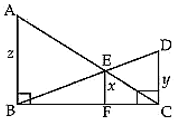
From the given figure, find the relation between x, y and z if AB, EF and DC are perpendicular to BC.
Answer & explanation
Correct answer: option 3
The correct answer is Option (3) → \(xy=z(y-x)\)
AB, EF and DC are all perpendicular to BC, so they are parallel. A line parallel to one side of a triangle cuts off a similar triangle, so EF gives two pairs of similar triangles: CFE with CBA, and BFE with BCD. Let BF \(=a\) and FC \(=b\).
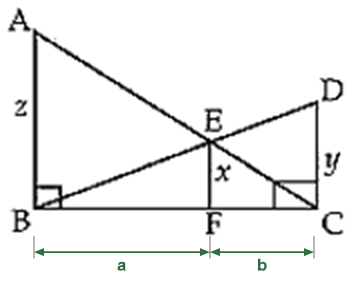
Triangle CFE is similar to triangle CBA (the sides at C):
\(\displaystyle \frac{EF}{AB}=\frac{FC}{BC}\), so \(\displaystyle \frac{x}{z}=\frac{b}{a+b}\) (1)
Triangle BFE is similar to triangle BCD (the sides at B):
\(\displaystyle \frac{EF}{DC}=\frac{BF}{BC}\), so \(\displaystyle \frac{x}{y}=\frac{a}{a+b}\) (2)
Adding (1) and (2), the lengths a and b cancel:
\(\displaystyle \frac{x}{z}+\frac{x}{y}=\frac{a+b}{a+b}=1\)
\(\displaystyle \frac{1}{z}+\frac{1}{y}=\frac{1}{x}\)
\(\displaystyle \frac{1}{x}-\frac{1}{y}=\frac{1}{z}\)
\(\displaystyle \frac{y-x}{xy}=\frac{1}{z}\)
\(xy=z(y-x)\)
Tip: The result \(\frac{1}{x}=\frac{1}{y}+\frac{1}{z}\) holds whatever the distance between the two poles, since a and b cancel; it is worth knowing for any question with two poles and crossing lines from their tops.