CUETMOCK
  • Pricing
  • Mentors
Log inStart freeStart free mocks→

First test, then trust

Try a free CUET mock test.

Join 5,00,000+ students who rehearsed exam day on the exact NTA screen before sitting CUET. On the web and on Android.

Start free mocks →Get the Android app
CUETMOCK

India's #1 CUET Mock Test Platform. Original NCERT-based questions on the exact NTA exam screen — trusted by 5,00,000+ students since CUET 2022.

Get it onGoogle PlayScan to download the CUETMOCK app

Mock tests

  • CUET mock test series
  • Browse all papers
  • Commerce mocks
  • Humanities (Arts) mocks
  • Science mocks
  • Languages & GAT mocks
  • Free practice questions
  • Pricing

Resources

  • CUET exam guide
  • CUET syllabus
  • Universities accepting CUET
  • Expert blogs
  • News & notifications
  • Webinars & counselling
  • CUET score calculator
  • How we estimate your rank
  • FAQs

Company

  • About us
  • Our leadership & team
  • Our toppers
  • Mentors
  • For schools
  • Contact us
  • Terms
  • Privacy
  • Refund policy

Talk to us

+91 7696 6630 56info@cuetmock.comWhatsApp us

Our other platforms

  • JEE Mock — For IIT-JEE aspirants
  • NEET Mock — For NEET aspirants

Newsletter

Exam updates, study material and offers — no spam.

© 2026 NYC Ventures Pvt. Ltd.

701-702, Royal Business Park, Zirakpur, Punjab - 140603

  • Terms of use
  • Privacy policy
  • Refund policy
  • Contact us

iCUETMOCK is an independent preparation platform, not affiliated with the National Testing Agency (NTA). Always check exam details on the official NTA website.

  • Home
  • Mock tests
  • CUET guide
  • Pricing
  • Log in
Home/Practice questions/History
HistoryModern India: Rebels and the Raj

The experience of François Sisten is important:

The experience of François Sisten is important:

Answer & explanation+

Correct answer: option 1

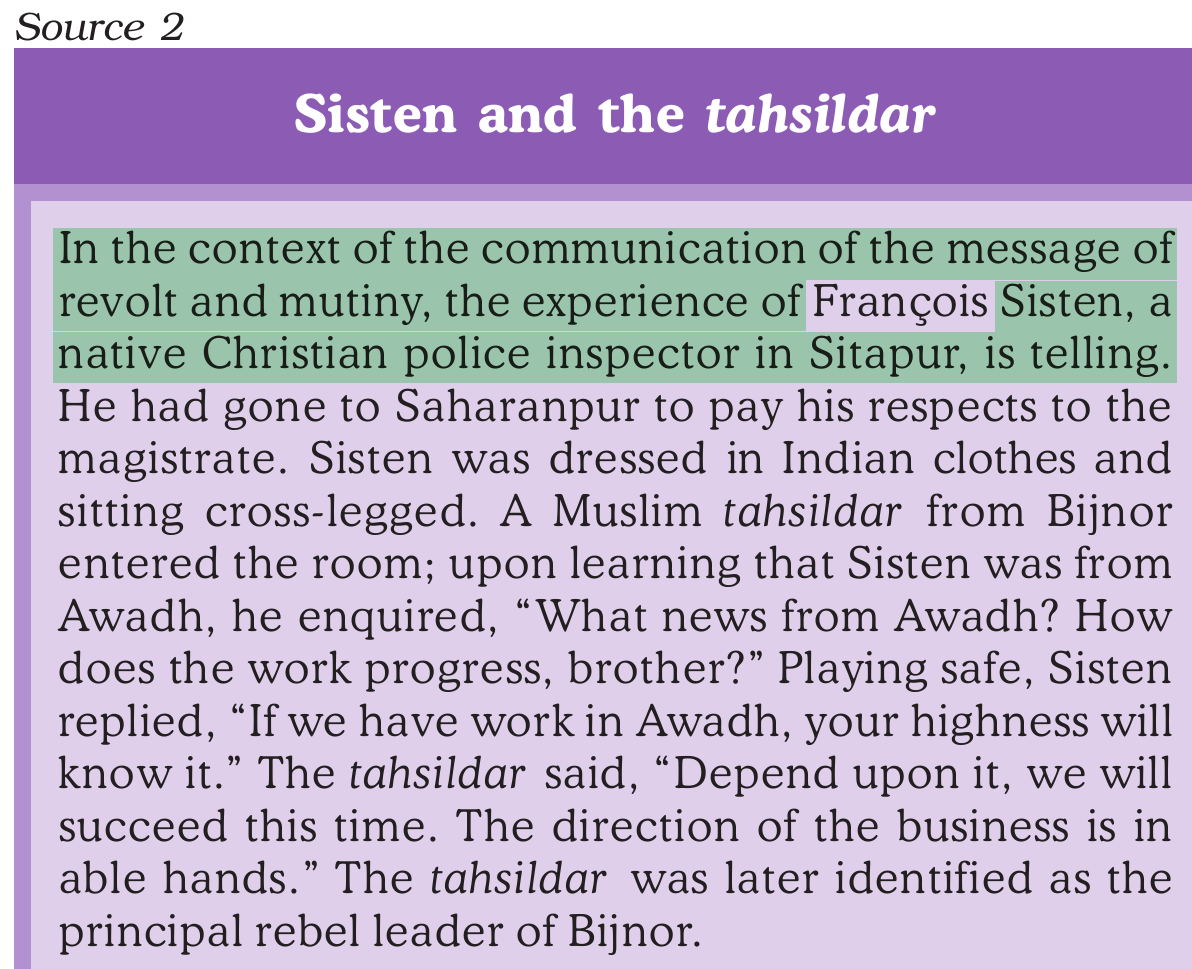
The correct answer is Option (1) → In the context of the communication of the message of revolt and mutiny

François Sisten, a native Christian police inspector, was taken by a Muslim tahsildar of Bijnor for one of the rebels and asked how “the work” in Awadh was progressing, so his account shows how the message of revolt was passed on and plans were discussed.


NCERT: Themes in Indian History Part III — Chapter 10: Rebels and the Raj (2026-27)

NCERT extract

Advertisement

Practise more on Modern India: Rebels and the Raj

Chapter-wise mocks on the real NTA exam screen, with solutions and your rank. Your first mocks are free.

Start free mocks →

Advertisement

Next questions

  1. When Jawaharlal Nehru was arrested in April 1930, he was on his way to attend a meeting of which body?History · Modern India: Mahatma Gandhi and the Nationalist movement
  2. Find the number that will come next in the following series. 3, 8, 22, 63, 185, ?General Aptitude Test · Verbal Reasoning
  3. Complete the following sentence using the correct determiner:Five buses go from the depot to the university every morning. You can catch __…English · Grammar: Determiner
  4. The area of the flower bed (A(x)) is given by:Maths. Section B1 · Applications of Derivatives
  5. Name the author of book “Economy of permanence”.Political Science · Politics in India Since Independence: Politics of Planned Development
  6. From the following identify the qualities of a good brand name: (A) Symbolically eye catching (B) Neither obscene, negative nor vulgar (C)…Entrepreneurship · Enterprise marketing
  7. A satellite of mass m is orbiting the earth (of radius R) at a height h from its surface. The total energy of the satellite in terms of go,…Physics · Gravitation
  8. निम्नलिखित मुहावरों का उनके अर्थों के साथ मिलान कीजिए–सूची-Iसूची-IIA. रफूचक्कर होनाI. दुःखी दिखानाB. रोनी सूरत बनानाII. आरम्भ करनाC. श्रीगण…Hindi · व्याकरण - मुहावरे
  9. From the given figure, find the relation between x, y and z if AB, EF and DC are perpendicular to BC.General Aptitude Test · Quantitative Reasoning
  10. Revaluation is a decrease in the exchange rate in a pegged exchange rate system. As a result:Economics · Macro Economics: Open Economy Macro Economics