
Which of the following 3d series metals has the highest melting point?
Answer & explanation
Correct answer: option 1
The correct answer is Option (1) → Cr
Transition metals have high melting points because (n−1)d electrons as well as ns electrons take part in metallic bonding. Across the 3d series the melting point rises to a maximum at d5 and then falls, with manganese as an exception.
Cr (3d54s1) — the d5 metal: the highest of the four.
Mn (3d54s2) — an anomalously low value, well below Cr.
Fe (3d64s2) — past the d5 maximum, so lower than Cr.
Zn (3d104s2) — no 3d electrons take part in its metallic bonding; it is not even a hard metal, and has the lowest melting point here.
NCERT (2026-27 edition):
4.3.1 Physical Properties – “The transition metals (with the exception of Zn, Cd and Hg) are very hard and have low volatility. Their melting and boiling points are high. Fig. 4.1 depicts the melting points of transition metals belonging to 3d, 4d and 5d series. The high melting points of these metals are attributed to the involvement of greater number of electrons from (n-1)d in addition to the ns electrons in the interatomic metallic bonding. In any row the melting points of these metals rise to a maximum at d5 except for anomalous values of Mn and Tc and fall regularly as the atomic number increases.”
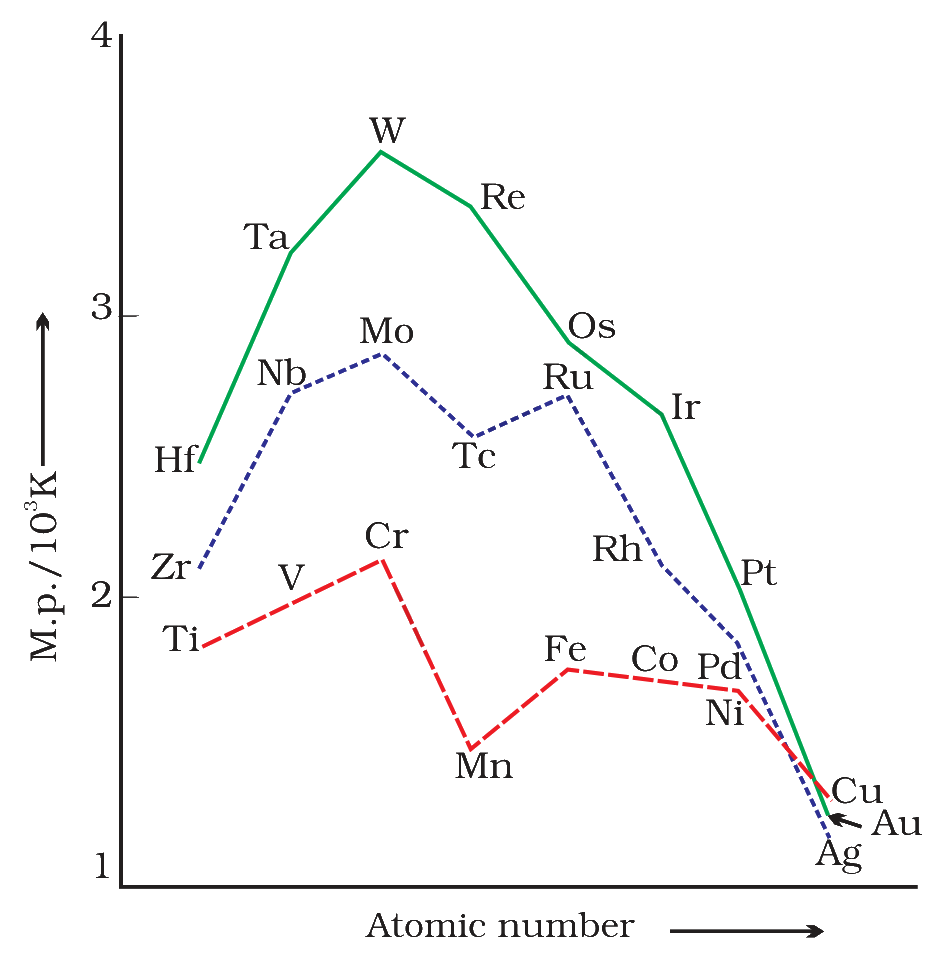
Fig. 4.1: Trends in melting points of transition elements