By a proper choice of reagents, both symmetrical and unsymmetrical ethers can be prepared by Williamson synthesis which involves the reaction between an alkyl halide and an alkoxide ion. The reverse process involving the cleavage of ethers to give back the original alkyl halide and the alcohol can be carried out by heating the ether with HI at 373K.
Allyl phenyl ether can be prepared by heating
Answer & explanation
Correct answer: option 2
The correct answer is Option (2) → CH2=CHCH2Br + C6H5ONa
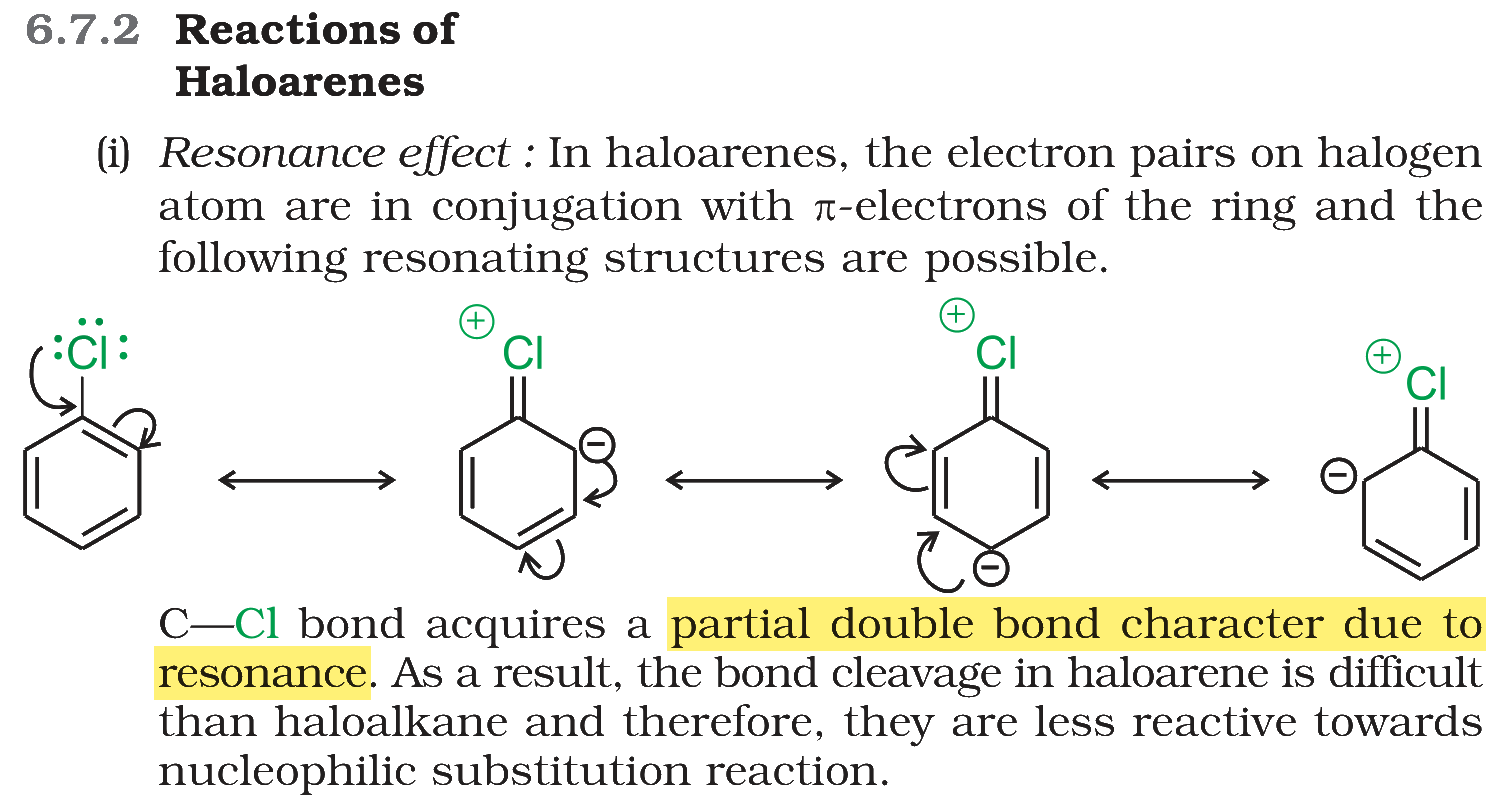
In the Williamson synthesis an alkoxide (or phenoxide) ion attacks the carbon of an alkyl halide by an SN2 reaction and pushes out the halide ion. The halide must be an alkyl halide. A halogen on a benzene ring is held by a bond with partial double bond character, so it is not replaced.
Allyl phenyl ether is \( \ce{C6H5-O-CH2-CH=CH2} \). The O–phenyl bond cannot be made by substitution at a ring carbon, so the phenyl part must come in as sodium phenoxide, and the allyl part as the halide. Allyl bromide is a primary halide whose C–Br carbon is sp3, so it reacts well:
\( \displaystyle \ce{CH2=CHCH2Br + C6H5ONa} \xrightarrow{\text{heat}} \ce{C6H5OCH2CH=CH2 + NaBr} \)
Why the other options are incorrect
Option (1) C6H5Br + CH2=CH-CH2ONa — Incorrect. Bromobenzene is an aryl halide. Its C–Br carbon is sp2 and the bond has partial double bond character, so the alkoxide cannot replace the bromine.
Option (3) C6H5CH=CHBr + CH3ONa — Incorrect.
\( \ce{C6H5CH=CHBr} \) is a vinylic halide: its bromine is on an sp2 carbon of a C=C, not on an alkyl carbon.
Even a substitution would give \( \ce{C6H5CH=CHOCH3} \), a methyl ether with no phenyl–O bond.
Option (4) CH2=CHBr + C6H5CH2ONa — Incorrect. Vinyl bromide is also a vinylic halide, not an alkyl halide. The pair could at best give benzyl vinyl ether, \( \ce{C6H5CH2OCH=CH2} \), a different compound.
NCERT (2026-27 edition):
2. Williamson synthesis – “… In this method, an alkyl halide is allowed to react with sodium alkoxide. … The reaction involves SN2 attack of an alkoxide ion on primary alkyl halide. … Phenols are also converted to ethers by this method. In this, phenol is used as the phenoxide moiety.”
6.7.2 Reactions of Haloarenes