Product (C) formed in above reaction is:
Answer & explanation
Correct answer: option 2
The correct answer is Option (2) → p-nitroaniline
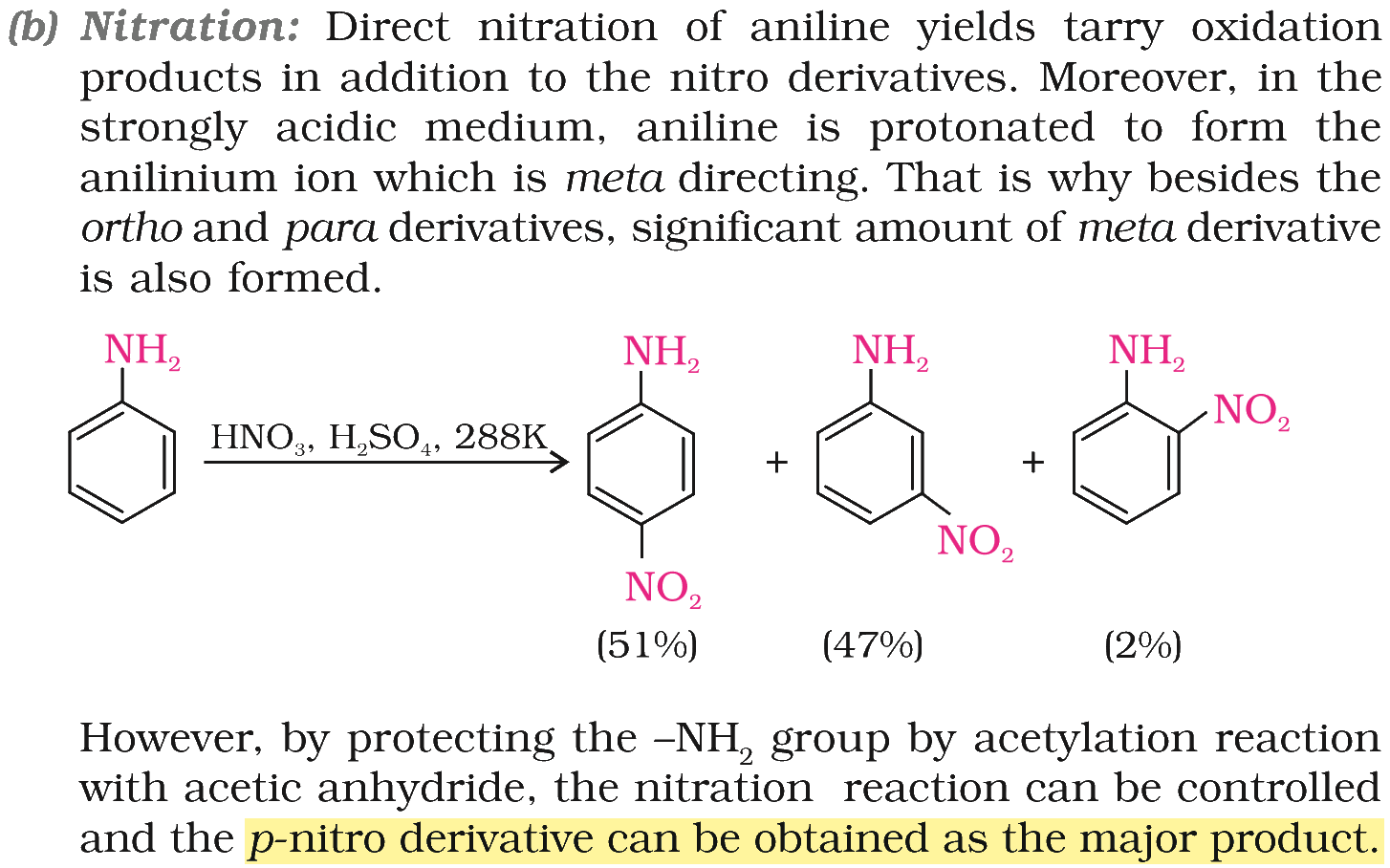
The –\( \ce{NH2} \) group activates the ring so strongly that direct nitration of aniline gives oxidation products and, in strong acid, much of the meta product (through the anilinium ion). The activating effect is controlled by protecting the –NH2 group by acetylation, carrying out the substitution, and then hydrolysing the amide back to the amine.
First, aniline is acetylated to acetanilide (A):
\( \ce{C6H5NH2 + (CH3CO)2O} \xrightarrow{\text{pyridine}} \ce{C6H5NHCOCH3 + CH3COOH} \)
Next, nitration gives p-nitroacetanilide (B) as the major product, because the –\( \ce{NHCOCH3} \) group is ortho, para-directing and bulky:
\( \ce{C6H5NHCOCH3 + HNO3} \xrightarrow[\text{288 K}]{\ce{H2SO4}} \text{p-}\ce{O2NC6H4NHCOCH3 + H2O} \)
Finally, acid hydrolysis removes the acetyl group and gives p-nitroaniline (C):
\( \text{p-}\ce{O2NC6H4NHCOCH3 + H2O} \xrightarrow{\ce{H+}} \text{p-}\ce{O2NC6H4NH2 + CH3COOH} \)
Why the other options are incorrect
Option (1) m-nitroaniline — Incorrect. The acetamido group is ortho, para-directing; the meta product comes from direct nitration of the anilinium ion, which is avoided here.
Option (3) o-nitroaniline — Incorrect. The ortho isomer is the minor product because the bulky –\( \ce{NHCOCH3} \) group hinders the ortho positions.
Option (4) p-nitroacetanilide — Incorrect. This is B; the last step, hydrolysis, removes the acetyl group, so C is the free amine.
NCERT (2026-27 edition):
Nitration