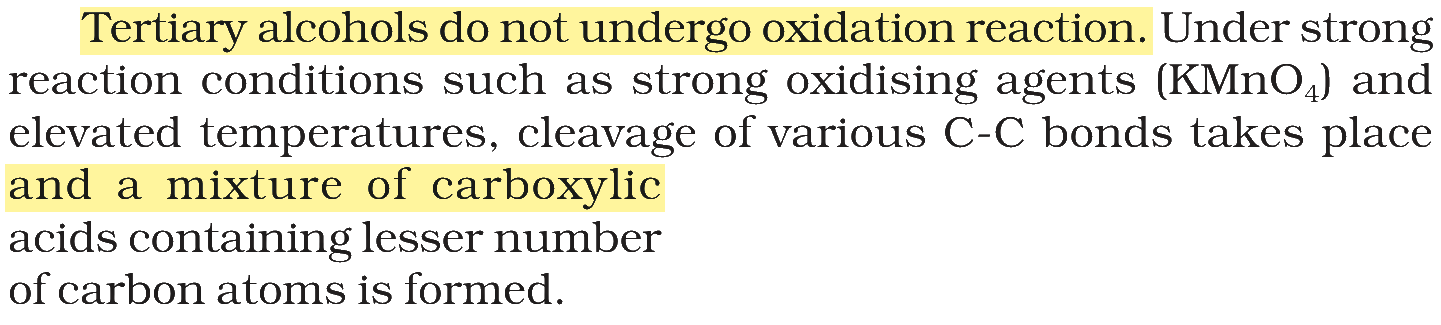
What is the product formed when tertiary alcohol is treated with alkaline \( KMnO_4 \) at elevated temperature?
Answer & explanation
Correct answer: option 3
The correct answer is Option (3) → A mixture of carboxylic acids
Oxidation of an alcohol removes the hydrogen on the carbon that carries the –OH group (the carbinol carbon). Primary and secondary alcohols have such a hydrogen; a tertiary alcohol has none, so it is not oxidised under ordinary conditions.
\( \displaystyle \ce{RCH2OH} \xrightarrow{[\mathrm{O}]} \ce{RCHO} \xrightarrow{[\mathrm{O}]} \ce{RCOOH} \qquad \ce{R2CHOH} \xrightarrow{[\mathrm{O}]} \ce{R2CO} \)
Under strong conditions a tertiary alcohol can react only by cleavage of its C–C bonds, so it gives a mixture of smaller carboxylic acids.
Why the other options are incorrect
Option (1) Ketone — Incorrect. A ketone is the oxidation product of a secondary alcohol, which has one hydrogen on the carbinol carbon.
Option (2) Aldehyde — Incorrect. An aldehyde comes from a primary alcohol under mild conditions, for example with PCC.
Option (4) Carboxylic acid — Incorrect. A single carboxylic acid with the same number of carbon atoms is obtained from a primary alcohol with a strong oxidising agent; a tertiary alcohol breaks into several smaller acids.
NCERT (2026-27 edition):
Oxidation – …