Blood cells swell, when placed in water containing less than 0.9% \(\left(\frac{mass}{volume}\right)\) salt solution. This is due to
Answer & explanation
Correct answer: option 2
The correct answer is Option (2) → Gain of water by osmosis
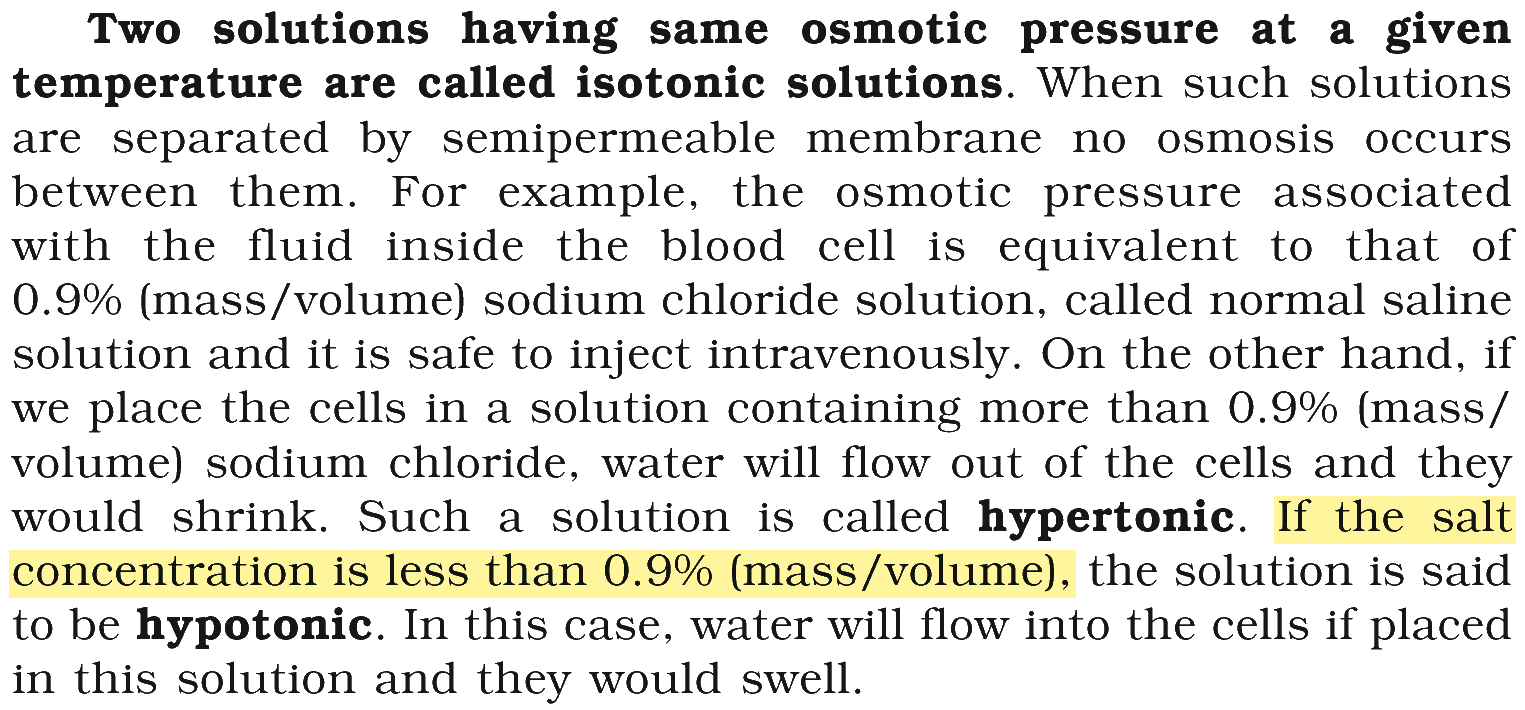
In osmosis, water flows through a semipermeable membrane from the more dilute solution to the more concentrated one. The fluid inside blood cells has the same osmotic pressure as a 0.9% (mass/volume) NaCl solution (normal saline).
In a solution containing less than 0.9% salt, the outside is more dilute than the cell fluid, so water flows into the cells; they swell and can burst. This is a gain of water by osmosis.
Why the other options are incorrect
Option (1) Reverse osmosis — Incorrect. It needs an external pressure greater than the osmotic pressure applied to the concentrated side; no such pressure acts here.
Option (3) Loss of water by osmosis — Incorrect. This happens in a solution containing more than 0.9% salt, where the cells shrink.
Option (4) Diffusion — Incorrect. Diffusion is the free spreading of particles; the movement of water here is through the cell membrane, i.e. osmosis.
NCERT (2026-27 edition):
Osmosis and Osmotic Pressure – …