ppm is
Answer & explanation
Correct answer: option 3
The correct answer is Option (3) → μg mL−1
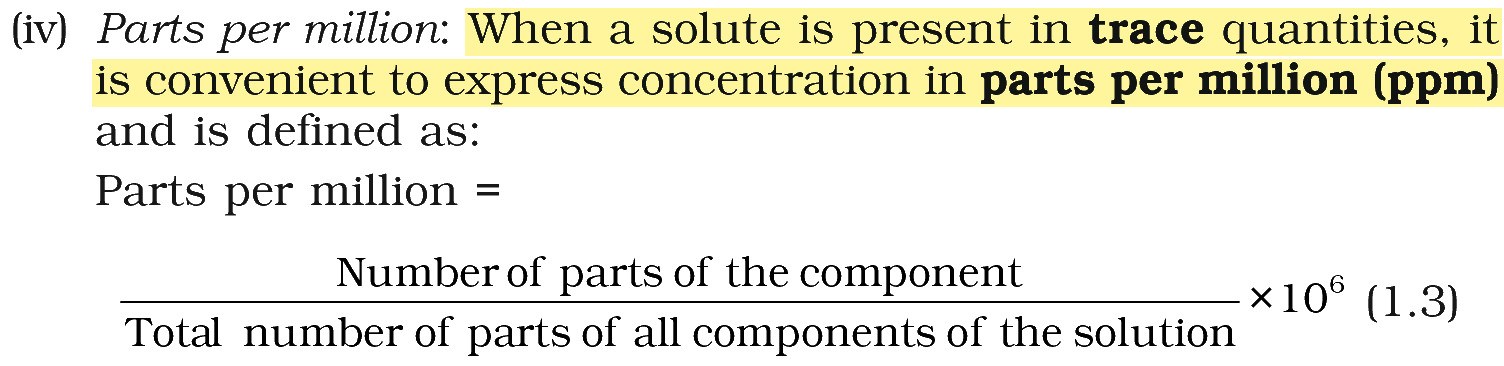
Parts per million (ppm) is used when a solute is present in trace amounts, for example fluoride or dissolved oxygen in water. It is the mass of the component in a million parts (by mass) of the solution:
\( \displaystyle \text{ppm}=\frac{\text{mass of component}}{\text{total mass of solution}}\times10^{6} \)
So 1 ppm means 1 g of solute in 106 g of solution:
\( \displaystyle 1\ \text{ppm}=\frac{1\ \mathrm{g}}{10^{6}\ \mathrm{g}}=\frac{10^{-6}\ \mathrm{g}}{1\ \mathrm{g}}=1\ \mathrm{\mu g\,g^{-1}} \)
Such a solution is almost pure water, whose density is about 1 g mL−1, so 1 g of solution occupies about 1 mL:
\( \displaystyle 1\ \text{ppm}\approx1\ \mathrm{\mu g\,mL^{-1}}=1\ \mathrm{mg\,L^{-1}} \)
So ppm corresponds to μg mL−1.
Why the other options are incorrect
Option (1) g L−1 — Incorrect. 1 g in 1000 mL (about 1000 g) is 1 part per thousand, that is 1000 ppm.
Option (2) mg mL−1 — Incorrect. 1 mg in 1 mL (about 1 g) is also 1 part per thousand, 1000 ppm.
Option (4) kg mL−1 — Incorrect. 1 kg in 1 mL is far more solute than solvent; it cannot describe a trace concentration.
NCERT (2026-27 edition):
Expressing Concentration of Solutions – …