
CUETMOCK
  • Pricing
  • Mentors
Log inStart freeStart free mocks→

First test, then trust

Try a free CUET mock test.

Join 5,00,000+ students who rehearsed exam day on the exact NTA screen before sitting CUET. On the web and on Android.

Start free mocks →Get the Android app
CUETMOCK

India's #1 CUET Mock Test Platform. Original NCERT-based questions on the exact NTA exam screen — trusted by 5,00,000+ students since CUET 2022.

Get it onGoogle PlayScan to download the CUETMOCK app

Mock tests

  • CUET mock test series
  • Commerce mocks
  • Humanities (Arts) mocks
  • Science mocks
  • Languages & GAT mocks
  • Free practice questions
  • Pricing

Resources

  • CUET exam guide
  • CUET syllabus
  • Universities accepting CUET
  • Expert blogs
  • News & notifications
  • Webinars & counselling
  • CUET score calculator
  • How we estimate your rank
  • FAQs

Company

  • About us
  • Our leadership & team
  • Our toppers
  • Mentors
  • For schools
  • Contact us
  • Terms
  • Privacy
  • Refund policy

Talk to us

+91 7696 6630 56info@cuetmock.comWhatsApp us

Our other platforms

  • JEE Mock — For IIT-JEE aspirants
  • NEET Mock — For NEET aspirants

Newsletter

Exam updates, study material and offers — no spam.

© 2026 NYC Ventures Pvt. Ltd.

701-702, Royal Business Park, Zirakpur, Punjab - 140603

  • Terms of use
  • Privacy policy
  • Refund policy
  • Contact us

iCUETMOCK is an independent preparation platform, not affiliated with the National Testing Agency (NTA). Always check exam details on the official NTA website.

  • Home
  • Mock tests
  • CUET guide
  • Pricing
  • Log in
Home/Practice questions/Physics
PhysicsSemiconductors and Electronic Devices

Two ideal diodes are connected to a battery as shown in the circuit.…

Two ideal diodes are connected to a battery as shown in the circuit. The current supplied by the battery is
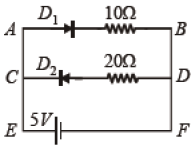
Figure for the question

Answer & explanation+

Correct answer: option 4

The correct answer is Option (4) → 0.5 A

An ideal diode has zero resistance when forward biased (its arrow points from the higher to the lower potential). It passes no current when reverse biased.

From the figure, the positive terminal of the 5 V cell is on the E side. So A and C are at the higher potential, and B and D are at the lower potential.

  • D1 points from A to B, so it is forward biased and the \( 10\,\Omega \) branch conducts.

  • D2 points from D to C, so it is reverse biased and the \( 20\,\Omega \) branch carries no current.

The whole battery current flows through the \( 10\,\Omega \) resistor:

    \( \begin{aligned} I &= \frac{V}{R} \\ &= \frac{5\,\mathrm{V}}{10\,\Omega} \\ &= 0.5\,\mathrm{A} \end{aligned} \)

Advertisement

Practise more on Semiconductors and Electronic Devices

Chapter-wise mocks on the real NTA exam screen, with solutions and your rank. Your first mocks are free.

Start free mocks →

Advertisement

Next questions

  1. 'हंसवाहिनी' (हंस है वाहन जिसका, वह अर्थात् सरस्वती) में कौन-सा समास है?Hindi · समास
  2. Which of the following imaginary lines passes through India?General Aptitude Test · General Knowledge
  3. Take the statements below to be true, even if they differ from known facts. Which of the conclusions follow logically from them?Statements:…General Aptitude Test · Verbal Reasoning
  4. मूक होइ वाचाल, पंगु चढ़े गिरिवर गहनजासु कृपा सो दयाल, द्रवहु सकल कलिमल दहनउपर्युक्त पंक्तियाँ किस छंद में हैं?Hindi · छंद
  5. The Padshahnama, written by Abdul Hamid Lahori, is the official history of the reign of which Mughal emperor?General Aptitude Test · General Knowledge
  6. Select the option that fits in the place of the question mark to complete the pattern.General Aptitude Test · Non-Verbal Reasoning
  7. 'दीवार' शब्द का सही बहुवचन रूप है -Hindi · वचन
  8. निम्नलिखित पंक्ति में कौन-सा अलंकार है?"घास पर ओस की बूँदें चमक रही थीं, जनु किसी ने मोती बिखेर दिए हों।"Hindi · अलंकार
  9. Arrange the following compounds in increasing order of boiling points.(A) Propan-1-ol(B) Butan-1-ol(C) Butan-2-ol(D) Pentan-1-olChoose the…Chemistry · Organic: Alcohols, Phenols and Ethers
  10. From the sixteenth century, in which centres did the Deccani School of painting flourish?Fine Arts · The Rajasthani Schools of Painting