
Arrange the following compounds in increasing order of boiling points.
(A) Propan-1-ol
(B) Butan-1-ol
(C) Butan-2-ol
(D) Pentan-1-ol
Choose the correct answer from the options given below:
Answer & explanation
Correct answer: option 2
The correct answer is Option (2) → (A) < (C) < (B) < (D)
All four compounds are alcohols, so all of them form hydrogen bonds; the order is decided by the van der Waals forces between the alkyl parts. Two factors act:
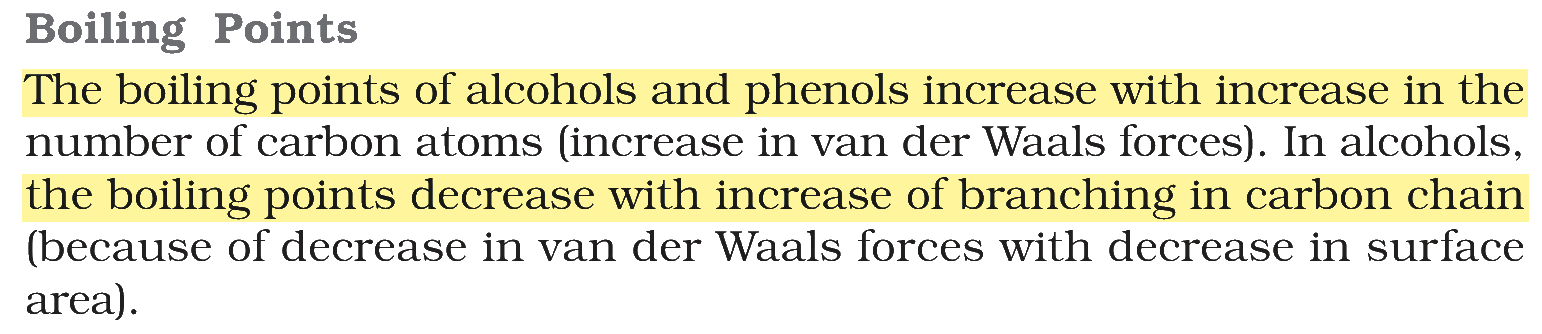
The boiling point rises with the number of carbon atoms, because larger molecules have stronger van der Waals forces.
For the same number of carbon atoms, the boiling point falls with branching, because a branched molecule is more compact and has a smaller surface area for contact.
(A) Propan-1-ol, \( \ce{CH3CH2CH2OH} \): three carbon atoms, the smallest; b.p. about 370 K.
(C) Butan-2-ol, \( \ce{CH3CH2CH(OH)CH3} \): four carbon atoms, but branched at the carbon carrying –OH; b.p. about 373 K.
(B) Butan-1-ol, \( \ce{CH3(CH2)3OH} \): four carbon atoms in a straight chain; b.p. about 390 K.
(D) Pentan-1-ol, \( \ce{CH3(CH2)4OH} \): five carbon atoms, the largest; b.p. about 411 K.
In increasing order of boiling point:
\( \displaystyle \text{propan-1-ol} \lt \text{butan-2-ol} \lt \text{butan-1-ol} \lt \text{pentan-1-ol} \)
Shortcut: Options (1) and (2) both start with (A) and end with (D). The branched butan-2-ol (C) boils below butan-1-ol (B), so only Option (2) fits.
NCERT (2026-27 edition):
Boiling Points
Note: The same/similar question has been asked in different years by NTA as per the details given below:
| 2026 | 2025 | 2024 | 2023 | 2022 |
|---|---|---|---|---|
| 25-05 S1 | 21-05 S1 | – | – | – |