
Charges \( +q \), \( +2q \), \( +q \) and \( -q \) are placed at the corners A, B, C and D respectively of a square ABCD, as shown in the figure. What is the magnitude of the electric field at the intersection of the diagonals of the square when \( q=\frac{5}{3}\times10^{-9}\,\mathrm{C} \) and each side of the square is 10 cm?
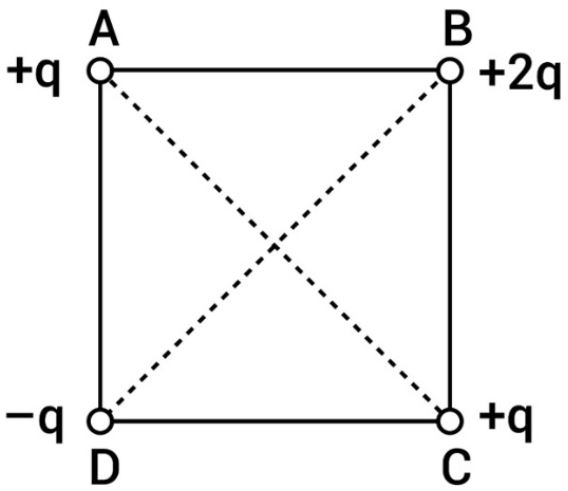
Answer & explanation
Correct answer: option 4
The correct answer is Option (4) → \( 0.9\times10^{4}\,\mathrm{V\,m^{-1}} \)
By the superposition principle, the field at the centre O is the vector sum of the fields of the four corner charges. Each field has magnitude \( k|q|/r^{2} \), where \( r \) is half the diagonal. A positive charge’s field at O points away from it and a negative charge’s field points towards it.
From the figure, the field directions at O are:
A (\( +q \)) and C (\( +q \)) are at opposite corners, so their equal fields are opposite and their sum is zero.
B (\( +2q \)) gives a field along BD, away from B. D (\( -q \)) gives a field along BD, towards D. These two add.
The data in SI units are:
\( \begin{aligned} r^{2} &= \left(\frac{0.1\,\mathrm{m}}{\sqrt{2}}\right)^{2} \\ &= 5\times10^{-3}\,\mathrm{m^{2}} \end{aligned} \)
\( \begin{aligned} kq &= 9\times10^{9}\,\mathrm{N\,m^{2}\,C^{-2}}\times\frac{5}{3}\times10^{-9}\,\mathrm{C} \\ &= 15\,\mathrm{N\,m^{2}\,C^{-1}} \end{aligned} \)
The resultant field at O, along BD, is:
\( \begin{aligned} E &= \frac{k(2q)}{r^{2}}+\frac{kq}{r^{2}} \\ &= \frac{3\times15\,\mathrm{N\,m^{2}\,C^{-1}}}{5\times10^{-3}\,\mathrm{m^{2}}} \\ &= 9\times10^{3}\,\mathrm{V\,m^{-1}} \\ &= 0.9\times10^{4}\,\mathrm{V\,m^{-1}} \end{aligned} \)