When mixture of Ethanal and Propanal are treated with NaOH solution, followed by heat, which among the following is not obtained as a product ?
Answer & explanation
Correct answer: option 4
The correct answer is Option (4) → Mesityl Oxide
Aldehydes and ketones that have at least one α-hydrogen undergo aldol condensation with dilute NaOH. The base removes an α-hydrogen to form a carbanion (enolate), which adds to the C=O group of a second molecule to give a β-hydroxy aldehyde (aldol). On heating, the aldol loses water to give an α,β-unsaturated aldehyde.
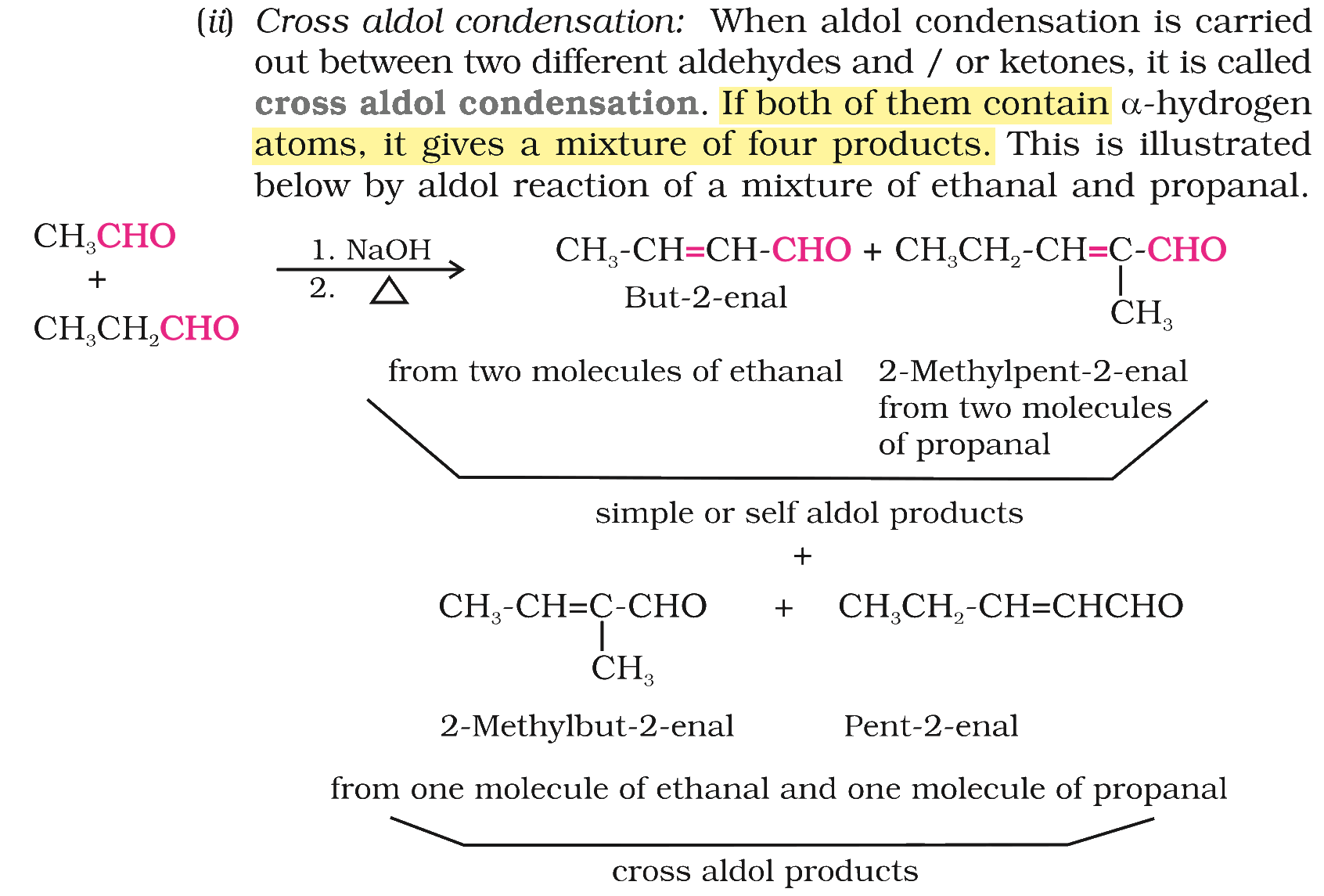
When two different aldehydes with α-hydrogens are used, this is a cross aldol condensation. Each aldehyde can act both as the carbanion and as the carbonyl partner, so all the products are aldehydes.
Mesityl oxide, \( \ce{(CH3)2C=CHCOCH3} \) (4-methylpent-3-en-2-one), is a ketone. It is formed by the aldol condensation of two molecules of propanone (acetone):
\( \displaystyle \ce{2CH3COCH3} \xrightarrow[\text{heat}]{\text{dil. }\ce{NaOH}} \ce{(CH3)2C=CHCOCH3 + H2O} \)
Option (1) Pent-2-enal — Obtained. The carbanion of ethanal adds to the C=O group of propanal, and the aldol then loses water.
Option (2) 2-Methylbut-2-enal — Obtained. The carbanion of propanal adds to the C=O group of ethanal; the methyl group comes from the α-carbon of propanal.
Option (3) 2-Methylpent-2-enal — Obtained. It is the self condensation product of two propanal molecules.
Option (4) Mesityl Oxide — Not obtained. It is a ketone formed from propanone, and no ketone is present in a mixture of ethanal and propanal.
NCERT (2026-27 edition):
Cross Aldol Condensation