
The figure shows how the vapour pressures of a liquid solvent, of the same solvent in the frozen (solid) state and of a solution of a non-volatile solute in this solvent change with temperature.
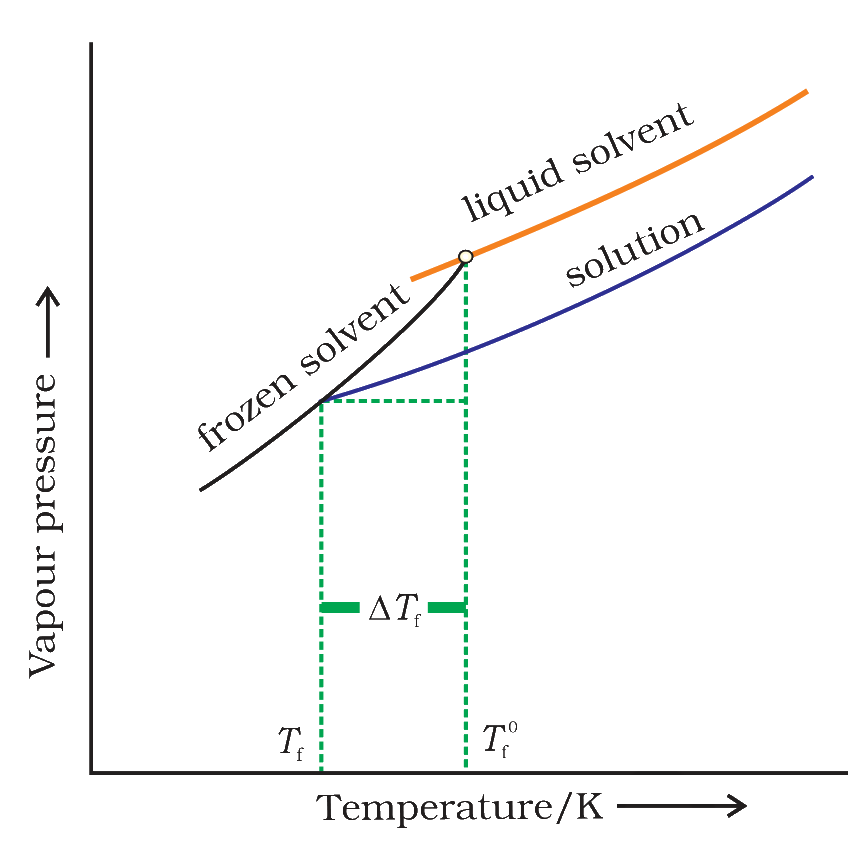
According to the figure, the freezing point of the solution, Tf, is the temperature at which:
Answer & explanation
Correct answer: option 2
The correct answer is Option (2) → the vapour pressure of the solution becomes equal to that of the frozen solvent
A liquid freezes at the temperature at which its vapour pressure in the liquid phase is equal to its vapour pressure in the solid phase. For a solution the solid that separates is the pure frozen solvent, so the solution freezes when its vapour pressure equals that of the frozen solvent.
Reading the figure — Tf is marked below the point where the solution curve meets the frozen solvent curve.
Why it is lower than Tf0 — the solution curve lies below the liquid-solvent curve, so it meets the frozen-solvent curve at a lower temperature. The gap between the two is ΔTf.
Why the other options are incorrect
Option (1) the vapour pressure of the solution becomes equal to that of the liquid solvent — Incorrect. The solution curve stays below the liquid-solvent curve at every temperature in the figure; the two never meet.
Option (3) the vapour pressure of the solution becomes equal to the atmospheric pressure — Incorrect. This is the condition for boiling, which gives the boiling point of the solution, not its freezing point.
Option (4) the vapour pressure of the liquid solvent becomes equal to that of the frozen solvent — Incorrect. This meeting point gives Tf0, the freezing point of the pure solvent, not of the solution.
NCERT (2026-27 edition):
1.6.3 Depression of Freezing Point – “The lowering of vapour pressure of a solution causes a lowering of the freezing point compared to that of the pure solvent (Fig. 1.8). … Thus, the freezing point of a substance may be defined as the temperature at which the vapour pressure of the substance in its liquid phase is equal to its vapour pressure in the solid phase. A solution will freeze when its vapour pressure equals the vapour pressure of the pure solid solvent as is clear from Fig. 1.8. According to Raoult’s law, when a non-volatile solid is added to the solvent its vapour pressure decreases and now it would become equal to that of solid solvent at lower temperature. Thus, the freezing point of the solvent decreases.”
Fig. 1.8: Diagram showing ΔTf, depression of the freezing point of a solvent in a solution.