Consider the following statements:
(A) Liberalisation of Indian industry gave firms freedom in deciding the scale of their business activities.
(B) Liberalisation of Indian industry gave firms freedom in fixing the prices of goods and services.
(C) Liberalisation of Indian industry included an increase in tax rates on business.
(D) Liberalisation of Indian industry included the free movement of people across borders.
How many of the statements given above are correct?
Answer & explanation
Correct answer: option 2
The correct answer is Option (2) → Only two
(A) Liberalisation of Indian industry gave firms freedom in deciding the scale of their business activities. — Correct. Liberalisation gave freedom in deciding the scale of business. There were no restrictions on expanding or cutting down business activities.
(B) Liberalisation of Indian industry gave firms freedom in fixing the prices of goods and services. — Correct. Liberalisation gave freedom in fixing the prices of goods and services.
(C) Liberalisation of Indian industry included an increase in tax rates on business. — Incorrect. Liberalisation brought a reduction in tax rates, along with the lifting of unnecessary controls over the economy.
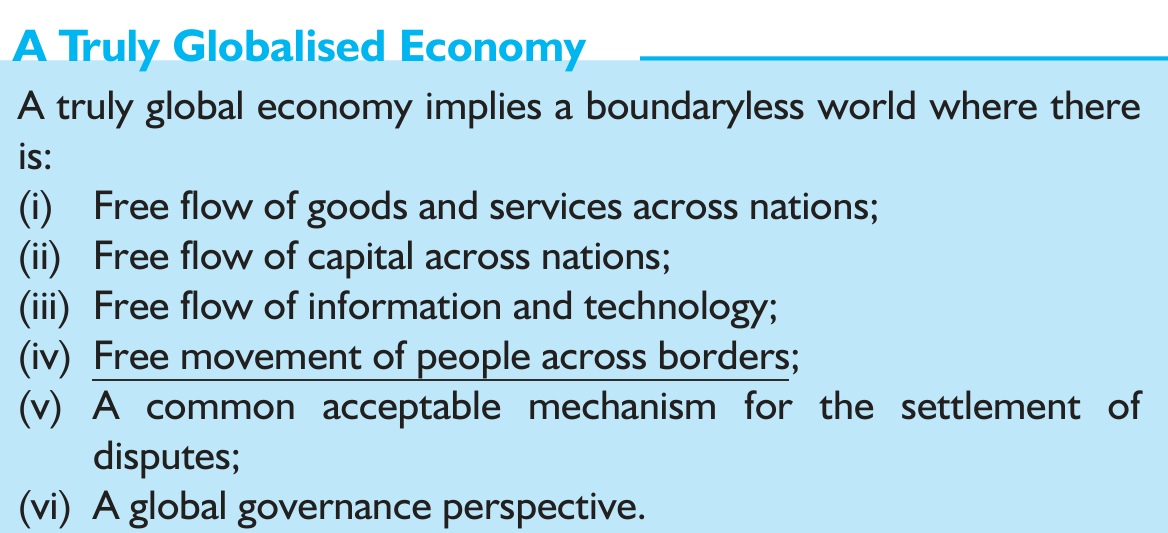
(D) Liberalisation of Indian industry included the free movement of people across borders. — Incorrect. Free movement of people across borders is a mark of a truly global economy. It belongs to globalisation.
Liberalisation frees industry from controls inside the country. Globalisation links the country’s economy with the other economies of the world.
NCERT (2026-27 Edition): “Liberalisation: The economic reforms that were introduced were aimed at liberalising the Indian business and industry from all unnecessary controls and restrictions. They signalled the end of the licence-pemit-quota raj. Liberalisation of the Indian industry has taken place with respect to:
|