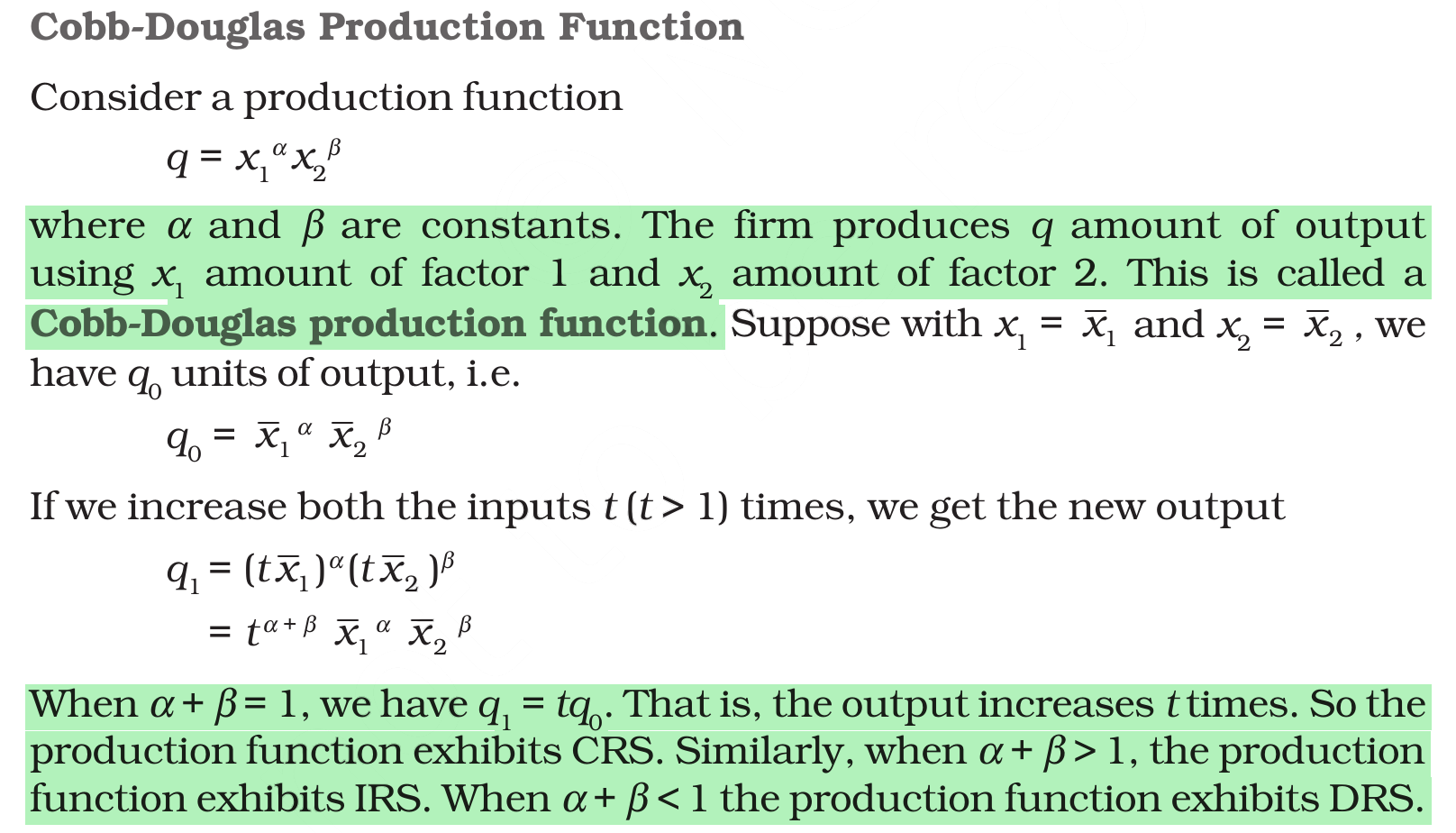
The given Cobb-Douglas production function
Q = L2/3K1/3, which of the following is correct about this production function?
A. The firm produces Q amount of output using L and K inputs only.
B. The given production function exhibits decreasing returns to scale.
C. The given production function exhibits constant returns to scale.
D. The given production function exhibits increasing returns to scale.
Choose the correct answer from the options given below:
Answer & explanation
Correct answer: option 3
The correct answer is Option (3) → A and C only
A production function tells us how much output a firm gets from its inputs. In the Cobb-Douglas production function, q = x1αx2β, the firm uses x1 units of factor 1 and x2 units of factor 2, α and β are constants, and the sum of the exponents, α + β, decides the returns to scale. Here Q = L2/3K1/3, with labour and capital as the factors, α = 2/3 and β = 1/3.
Returns to scale describe what happens to output when every input is scaled up in the same proportion, which is possible only in the long run. So we multiply both L and K by the same factor t and see what becomes of Q:
Q = L2/3K1/3
Q’ = (tL)2/3(tK)1/3
Q’ = t2/3L2/3 · t1/3K1/3
Q’ = t2/3 + 1/3 · L2/3K1/3
Q’ = t1 · Q = tQ
Output has been multiplied by t itself, the same factor as the inputs: double both inputs and output doubles. That is constant returns to scale. In general the t terms collect into one power, tα+β, so the sum of the exponents settles the case:
α + β > 1 — increasing returns to scale
α + β = 1 — constant returns to scale
α + β < 1 — decreasing returns to scale
Here α + β = 2/3 + 1/3 = 1, the middle case, so statements A and C hold:
(A) The firm produces Q amount of output using L and K inputs only. True. Labour and capital are the only two inputs in the function.
(B) The given production function exhibits decreasing returns to scale. False. That requires the exponents to sum to less than 1.
(C) The given production function exhibits constant returns to scale. True. The exponents sum to 1.
(D) The given production function exhibits increasing returns to scale. False. That requires the exponents to sum to more than 1.
NCERT: Introductory Microeconomics — Chapter 3: Production and Costs (2025-26)
|