
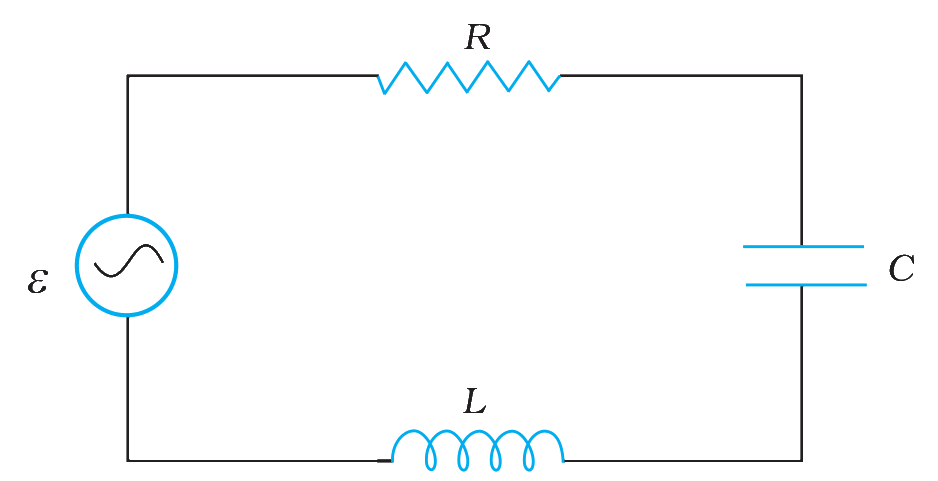
For the series LCR circuit shown, the source emf is E (marked \( \varepsilon \) in the figure), q is the charge on the capacitor and i is the current. Kirchhoff’s loop rule gives
Answer & explanation
Correct answer: option 3
The correct answer is Option (3) → \( L\frac{di}{dt}+iR+\frac{q}{C}=E \)
From the figure, the resistor, capacitor and inductor are in series with the source, so the same current i flows through all three. By Kirchhoff’s loop rule, the applied emf equals the sum of the voltages across the three elements. These are \( L\,di/dt \) across the inductor, \( iR \) across the resistor and \( q/C \) across the capacitor.
Option (1) \( L\frac{di}{dt}+iR-\frac{q}{C}=E \) — Incorrect. The voltage across the capacitor opposes the source in the same way as the other two terms. So all three voltages add with the same sign.
Option (2) \( L\frac{di}{dt}+iR-qC=E \) — Incorrect. Since \( C=q/V \), the voltage across a capacitor is \( q/C \). The product \( qC \) does not have the unit of voltage, and its sign is also wrong.
Option (3) \( L\frac{di}{dt}+iR+\frac{q}{C}=E \) — Correct. The sum of the voltages across the inductor, the resistor and the capacitor equals the source emf at every instant.
Option (4) \( L\frac{di}{dt}+iR+qC=E \) — Incorrect. The capacitor term must be \( q/C \), the voltage across the plates. The product \( qC \) does not have the unit of voltage.
NCERT (2026-27):
AC Voltage Applied to a Series LCR Circuit – “If q is the charge on the capacitor and i the current, at time t, we have, from Kirchhoff’s loop rule:
\( \displaystyle L\frac{di}{dt}+iR+\frac{q}{C}=v \)\( \qquad (7.20) \)”