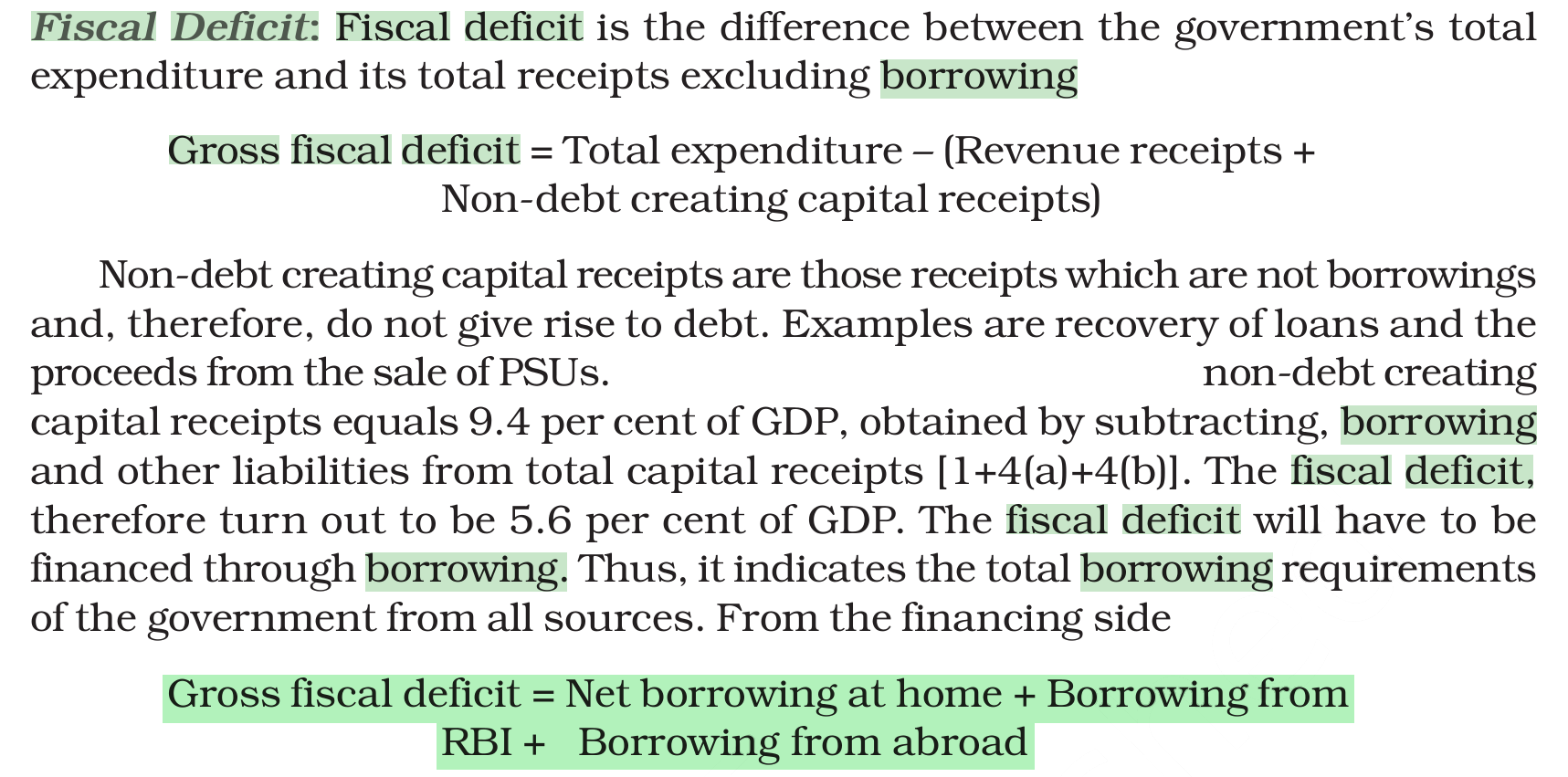
Choose the incorrect formula from the options given below.
Answer & explanation
Correct answer: option 4
The correct answer is Option (4) → Gross fiscal deficit = Net borrowing at home - Borrowing from RBI + Borrowing from abroad
The government’s budget has a revenue account, for receipts and spending that create no assets or liabilities (taxes, salaries, interest), and a capital account, for borrowing, recovery of loans, sale of assets and spending on assets. Its deficits measure the gap between what it spends and what it receives:
The revenue deficit is the excess of revenue expenditure over revenue receipts: the government is borrowing to meet its day-to-day spending.
The fiscal deficit is the excess of total expenditure over total receipts excluding borrowing. It shows how much the government has to borrow, so it can be measured from the spending side, or from the financing side as the sum of its borrowing from all sources, each source added.
Option (1) Revenue deficit = Revenue expenditure - Revenue receipts — Correct formula. Revenue expenditure such as salaries and interest is set against revenue receipts such as taxes, and the excess of revenue expenditure over revenue receipts is the revenue deficit.
Option (2) Gross Fiscal Deficit = Total Expenditure – (Revenue Receipts + Non-Debt Creating Capital Receipts) — Correct formula. This is the spending side. Non-debt creating capital receipts, such as recovery of loans and proceeds from the sale of PSUs, do not add to debt, so they are deducted along with revenue receipts; what is left has to be borrowed.
Option (3) Gross fiscal deficit = Net borrowing at home + Borrowing from RBI + Borrowing from abroad — Correct formula. This is the financing side: the deficit is met by borrowing at home, from the RBI and from abroad, and each of the three adds to the money the government can spend.
Option (4) Gross fiscal deficit = Net borrowing at home - Borrowing from RBI + Borrowing from abroad — Incorrect formula. Borrowing from the RBI is one of the sources that finance the deficit, so it is added, not deducted.
NCERT: Introductory Macroeconomics — Chapter 5: Government Budget and the Economy (2025-26)
|