
CUETMOCK
  • Pricing
  • Mentors
Log inStart freeStart free mocks→

First test, then trust

Try a free CUET mock test.

Join 5,00,000+ students who rehearsed exam day on the exact NTA screen before sitting CUET. On the web and on Android.

Start free mocks →Get the Android app
CUETMOCK

India's #1 CUET Mock Test Platform. Original NCERT-based questions on the exact NTA exam screen — trusted by 5,00,000+ students since CUET 2022.

Get it onGoogle PlayScan to download the CUETMOCK app

Mock tests

  • CUET mock test series
  • Browse all papers
  • Commerce mocks
  • Humanities (Arts) mocks
  • Science mocks
  • Languages & GAT mocks
  • Free practice questions
  • Pricing

Resources

  • CUET exam guide
  • CUET syllabus
  • Universities accepting CUET
  • Expert blogs
  • News & notifications
  • Webinars & counselling
  • CUET score calculator
  • How we estimate your rank
  • FAQs

Company

  • About us
  • Our leadership & team
  • Our toppers
  • Mentors
  • For schools
  • Contact us
  • Terms
  • Privacy
  • Refund policy

Talk to us

+91 7696 6630 56info@cuetmock.comWhatsApp us

Our other platforms

  • JEE Mock — For IIT-JEE aspirants
  • NEET Mock — For NEET aspirants

Newsletter

Exam updates, study material and offers — no spam.

© 2026 NYC Ventures Pvt. Ltd.

701-702, Royal Business Park, Zirakpur, Punjab - 140603

  • Terms of use
  • Privacy policy
  • Refund policy
  • Contact us

iCUETMOCK is an independent preparation platform, not affiliated with the National Testing Agency (NTA). Always check exam details on the official NTA website.

  • Home
  • Mock tests
  • CUET guide
  • Pricing
  • Log in
Home/Practice questions/Applied Maths. Section B2
Applied Maths. Section B2Financial Mathematics

Match the LIST-I with LIST-IILIST-ILIST-IIA. The present value of a p…

Match the LIST-I with LIST-II

LIST-ILIST-II
A. The present value of a perpetuity of Rs. 3120 payable at the beginning of each year, if money is worth 6 % effective.I. Rs. 2,00,000
B. The present value of a perpetuity of Rs. 5,000 payable at the end of each year, if money is worth 5 % compounded annuallyII. Rs. 1,50,000
C. The present value of a sequence of payments of Rs. 3,000 payable at the end of each 6 months and continuing forever, if money is worth 4 % compounded semi-annually.III. Rs. 1,00,000
D. The present value of a perpetuity of Rs. 3,000 payable at the end of each quarter, if money is worth 6 % compounded quarterlyIV. Rs. 55,120

Choose the correct answer from the options given below:

Answer & explanation+

Correct answer: option 3

The correct answer is Option (3) → A-IV, B-III, C-II, D-I

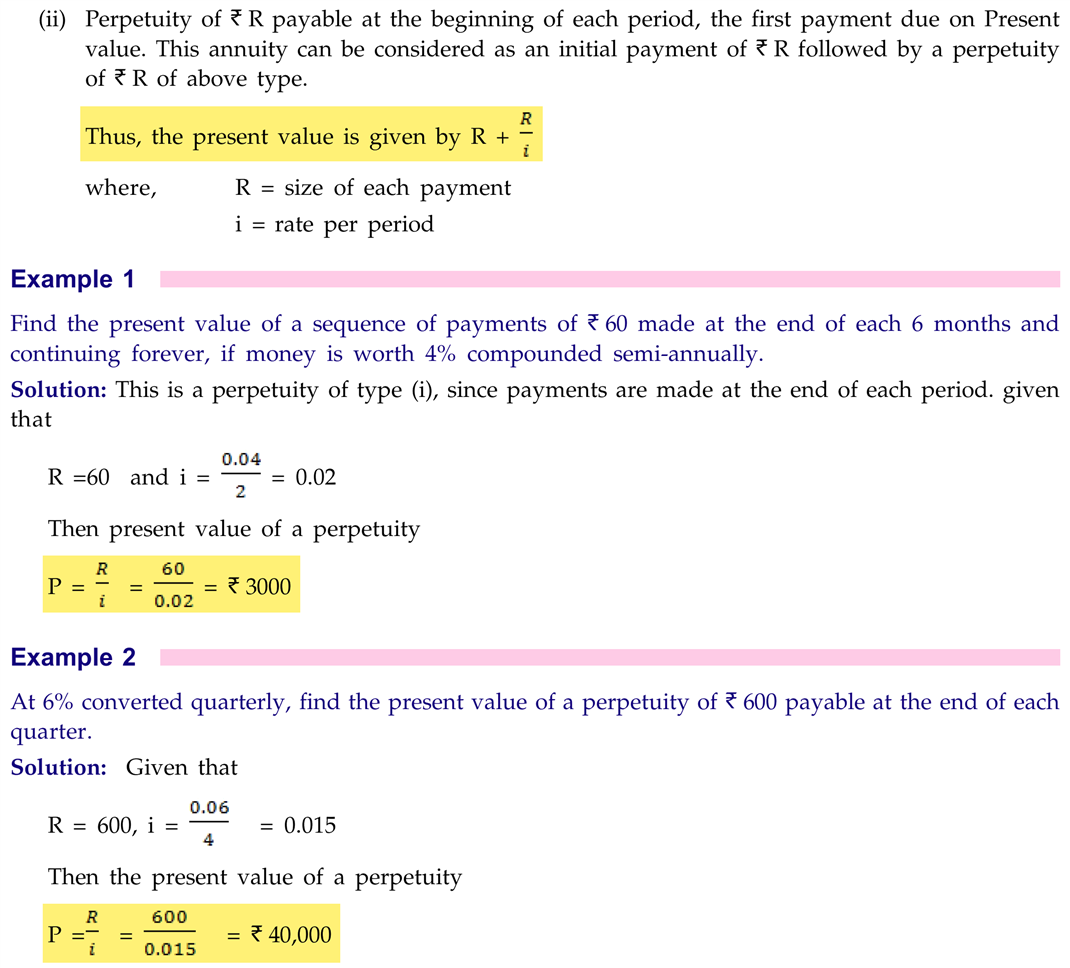
For a perpetuity of R per period at rate i per period, \( PV=\frac{R}{i} \) when payments are made at the end of each period, and \( PV=R+\frac{R}{i} \) when they are made at the beginning (perpetuity due). The rate i is always the rate per payment period.

A. The present value of a perpetuity of Rs. 3120 payable at the beginning of each year, if money is worth 6 % effective.

This matches IV. Rs. 55,120.

    \( \displaystyle PV=3120+\frac{3120}{0.06} \)

    \( \displaystyle =3120+52000 \)

    \( \displaystyle =55120 \)

B. The present value of a perpetuity of Rs. 5,000 payable at the end of each year, if money is worth 5 % compounded annually

This matches III. Rs. 1,00,000.

    \( \displaystyle PV=\frac{5000}{0.05}=100000 \)

C. The present value of a sequence of payments of Rs. 3,000 payable at the end of each 6 months and continuing forever, if money is worth 4 % compounded semi-annually.

This matches II. Rs. 1,50,000.

Rate per half-year: i = 4% ÷ 2 = 2% = 0.02.

    \( \displaystyle PV=\frac{3000}{0.02}=150000 \)

D. The present value of a perpetuity of Rs. 3,000 payable at the end of each quarter, if money is worth 6 % compounded quarterly

This matches I. Rs. 2,00,000.

Rate per quarter: i = 6% ÷ 4 = 1.5% = 0.015.

    \( \displaystyle PV=\frac{3000}{0.015}=200000 \)

So the matching is A-IV, B-III, C-II, D-I.

CBSE Applied Mathematics (Class XII):
Perpetuity
CBSE extract

Advertisement

Practise more on Financial Mathematics

Chapter-wise mocks on the real NTA exam screen, with solutions and your rank. Your first mocks are free.

Start free mocks →

Advertisement

Next questions

  1. The separated bands of DNA are cut out from the agarose gel and extracted from the gel piece. This step is known as:Biology · Biotechnology -Principles and Processes
  2. India is not a member of which of the following regional and global economic groups?Economics · Indian Economic Development: Comparative Development Experiences of India and its Neighbours
  3. Match List-I with List-II.List-IList-IIMicroorganismProduct(A) Saccharomyces cerevisiae(I) Butyric acid(B) Aspergillus niger(II) Statins(C)…Biology · Microbes in Human Welfare
  4. Read the statements given below and choose the option with the correct sequences. (A) The zamindars controlled the land(B) Green revolution…Sociology · Social Change and Development in India: Change and Development in Rural Society
  5. Release of DNA along with other macromolecules such as RNA, proteins, polysaccharides and lipids can be achieved by treating the bacterial…Biology · Biotechnology -Principles and Processes
  6. Reactions in which there is an exchange of ions between the reactants are called?General Aptitude Test · General Knowledge
  7. A square coil of 50 turns, each of side 10\ cm is held with its plane perpendicular to a magnetic field that varies with time as B(t) = 2t…Physics · Electromagnetic Induction
  8. The first transgenic cow is:Biology · Biotechnology and its Applications
  9. Arrange the given events of double fertilization in correct sequence.A. Fusion of second male gamete with two polar nucleiB. Fusion of firs…Biology · Sexual Reproduction in Flowering Plants
  10. ∫(x dx)/(x^2+3x+2) is equal to:(where c is an arbitrary constant)Applied Maths. Section A · Indefinite Integration (Section A)