In case of dissolution, match List-I with List-II.
| List-I | List-II | ||
|---|---|---|---|
| (A) | Partner's Loan is transferred to | (I) | Credit side of Partners' Capital Account |
| (B) | External Liabilities (appearing in balance sheet) are transferred to | (II) | Debit side of Partners' Capital Account |
| (C) | The accumulated profits and reserves are transferred to | (III) | Bank Account |
| (D) | The accumulated losses are transferred to | (IV) | Realisation A/c |
Choose the correct answer from the options given below:
Answer & explanation
Correct answer: option 1
The correct answer is Option (1) → (A) - (III), (B) - (IV), (C) - (I), (D) - (II)
On dissolution, outside liabilities go through the Realisation Account, while items that belong to the partners themselves go straight to their capital accounts or are paid off.
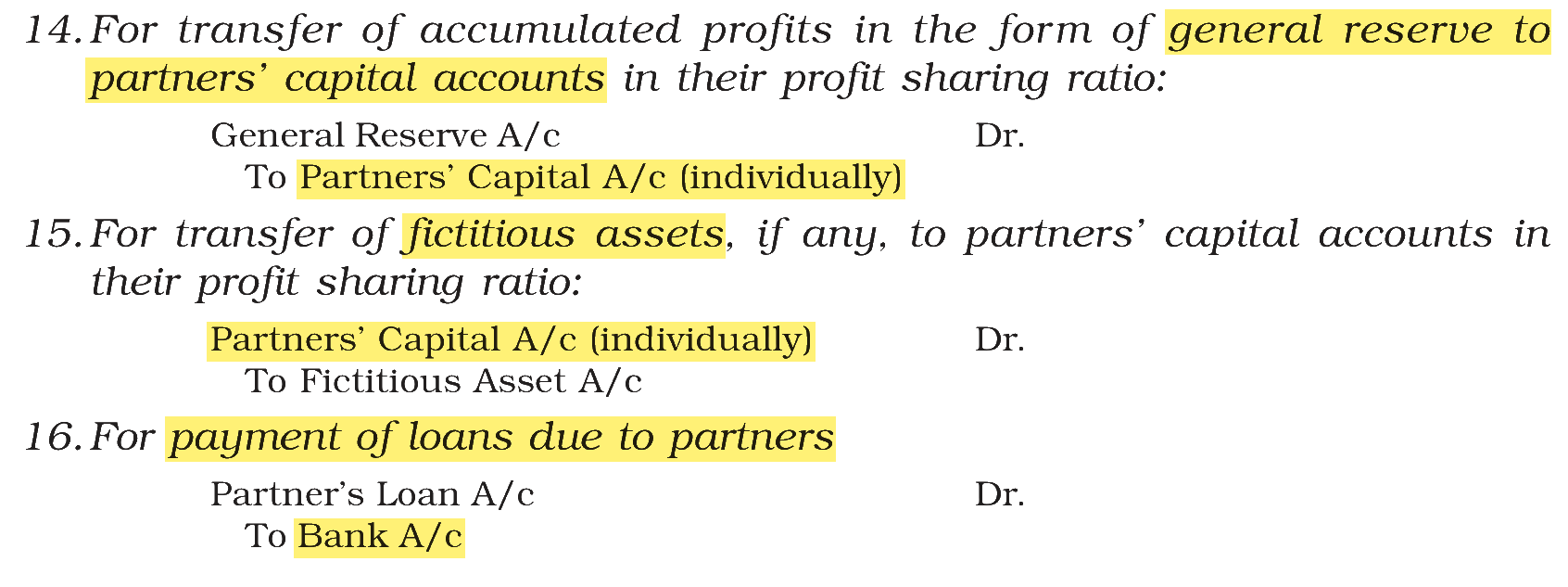
(A) Partner’s Loan is transferred to — this matches (III) Bank Account. A partner’s loan is not taken to the Realisation Account; it is paid off in cash after the outside debts, so Partner’s Loan A/c is debited and Bank A/c is credited.
(B) External Liabilities (appearing in balance sheet) are transferred to — this matches (IV) Realisation A/c. All outside liabilities, provisions included, are closed by transfer to the credit of the Realisation Account, and their payment is then debited to it.
(C) The accumulated profits and reserves are transferred to — this matches (I) Credit side of Partners’ Capital Account. Reserves belong to the partners, so they are credited to their capital accounts in the profit sharing ratio.
(D) The accumulated losses are transferred to — this matches (II) Debit side of Partners’ Capital Account. Accumulated losses and fictitious assets are borne by the partners, so their capital accounts are debited.
NCERT (2026-27 edition): NCERT (2026-27 edition):
|