CARBONYL COMPOUNDS
In aldehydes, the carbonyl group is bonded to a carbon and hydrogen while in the ketones, it is bonded to two carbon atoms. Aldehydes and ketones undergo nucleophilic addition reactions. A nucleophile attacks the electrophilic carbon atom of the polar carbonyl group from a direction approximately perpendicular to the plane of sp2 hybridized orbitals of carbonyl carbon. The hybridization of carbon changes from sp2 to sp3 in the nucleophilic addition. Aldehydes give Fehling’s test positive while aromatic aldehydes do not respond to this test .
An organic compound ‘A’ with molecular formula C3H5N, undergoes Stephen reaction to produce another compound ‘B’. Compound ‘B’ gives orange precipitate with 2,4-DNP but it does not undergo Haloform reaction. However, the reaction of compound B with dilute alkali produces a compound ‘C’ which is β-hydroxy compound with increased number of carbon atoms.
IUPAC name of compound ‘C’ is
Answer & explanation
Correct answer: option 1
The correct answer is Option (1) → 3-Hydroxy-2-methylpentanal.
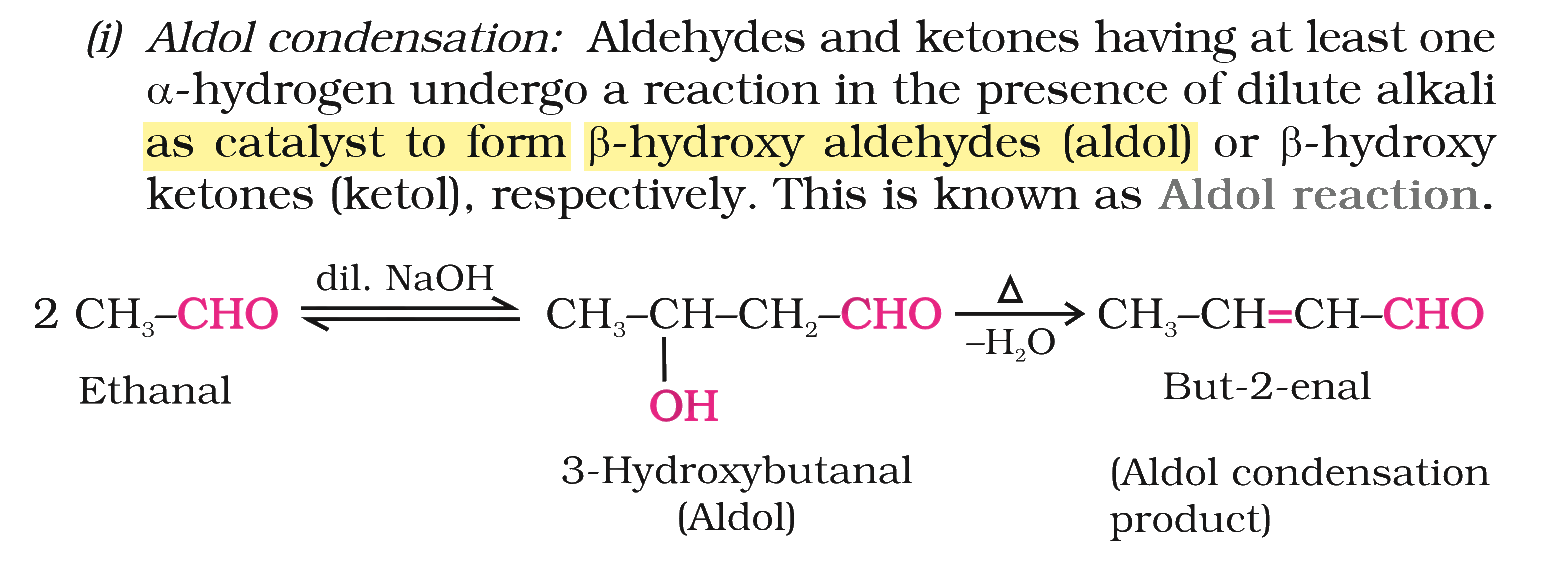
In the aldol reaction, dilute alkali removes an α-hydrogen from one aldehyde molecule. The carbanion formed attacks the carbonyl carbon of a second molecule, giving a β-hydroxy aldehyde. The new C–C bond joins the α-carbon of one molecule to the carbonyl carbon of the other.
From the passage, A is propanenitrile and B is propanal (formed by Stephen reduction). Two molecules of propanal combine:
\( \displaystyle \ce{CH3CH2CHO + CH3CH2CHO} \xrightarrow{\text{dil. NaOH}} \ce{CH3CH2CH(OH)-CH(CH3)-CHO} \)
Naming C, the longest chain containing the –CHO group has five carbons, numbered from the –CHO carbon:
5CH3–4CH2–3CH(OH)–2CH(CH3)–1CHO
The –OH group is on C3 and the methyl group on C2. So C is 3-hydroxy-2-methylpentanal, a six-carbon β-hydroxy aldehyde.
NCERT (2026-27 edition):
Aldol Condensation