
In a full-wave rectifier with a capacitor filter, the output voltage rises to the peak and then falls a little before the next pulse arrives. The load resistance \(R_L\) is now increased, while the capacitance \(C\) is kept the same. The output voltage will now
Answer & explanation
Correct answer: option 4
The correct answer is Option (4) → fall more slowly between the peaks, so it stays nearer the peak value
Between two peaks, the capacitor discharges through the load. How fast its voltage falls depends on the time constant \( CR_L \). A larger \( CR_L \) gives a slower fall.
Option (1) fall faster between the peaks, so the ripple becomes larger — Incorrect. A faster fall would need a smaller \( CR_L \). Here \( R_L \) has gone up, so \( CR_L \) is larger.
Option (2) fall to zero between two pulses — Incorrect. The output drops to zero between pulses only when there is no capacitor, as in the dotted curve of (b). The capacitor is still connected.
Option (3) show twice as many pulses every second — Incorrect. The number of pulses each second depends on the input frequency and the type of rectifier. Changing \( R_L \) does not change it.
Option (4) fall more slowly between the peaks, so it stays nearer the peak value — Correct. With a larger \( R_L \), the time constant \( CR_L \) increases. The capacitor loses less charge before the next pulse, so the ripple becomes smaller.
NCERT (2026-27):
Application of Junction Diode as a Rectifier – “… The rate of fall of the voltage across the capacitor depends inversely upon the product of capacitance C and the effective resistance RL used in the circuit and is called the time constant. …”
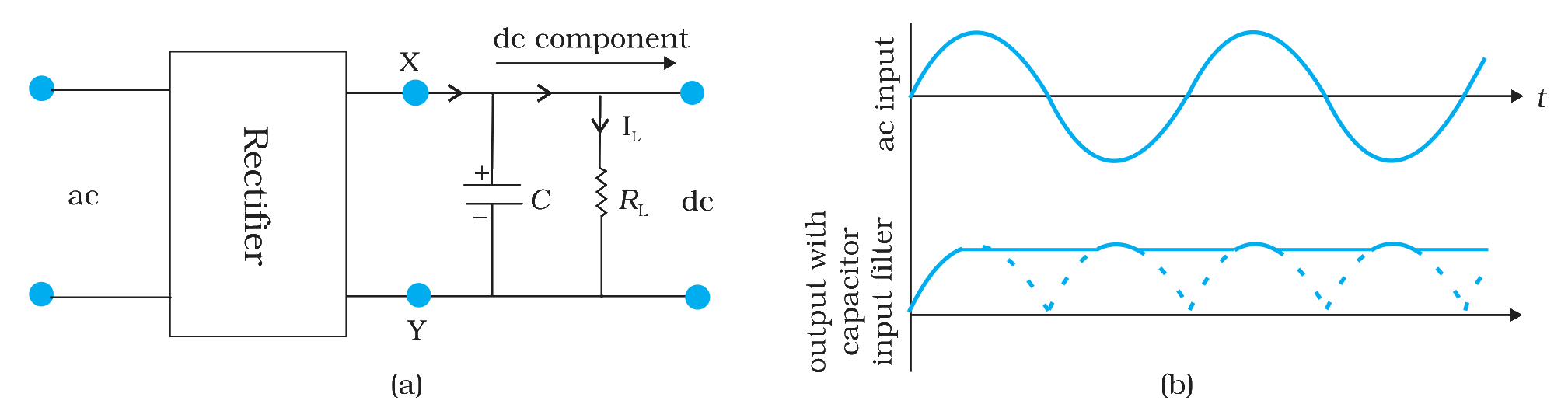
FIGURE 14.20 (a) A full-wave rectifier with capacitor filter, (b) Input and output voltage of rectifier in (a).