
A colloid is a heterogeneous system in which one substance is dispersed as very fine particles in another substance called dispersion medium. Colloids are classified on the basis of physical state of dispersed phase and dispersion medium, nature of interaction between dispersed phase and dispersion medium and types of particles of dispersed phase. There are various methods for the preparation of colloidal solutions such as chemical methods, electrical disintegration and peptization. Colloidal solutions when prepared, generally contain excessive amount of electrolytes, and some other soluble impurities. The process used for reducing the amount of impurities to a requisite minimum is known as purification of colloidal solution. Purification of colloidal solution is carried out by various methods such as Dialysis, Electrodialysis, Ultrafiltration etc. Colligative properties, Tyndall effect, colour, Brownian movement, charge on colloidal particles, electrophoresis, coagulation are various properties exhibited by colloidal solution.
Which among the given statements CANNOT be defined as the property of colloidal solution:
Answer & explanation
Correct answer: option 3
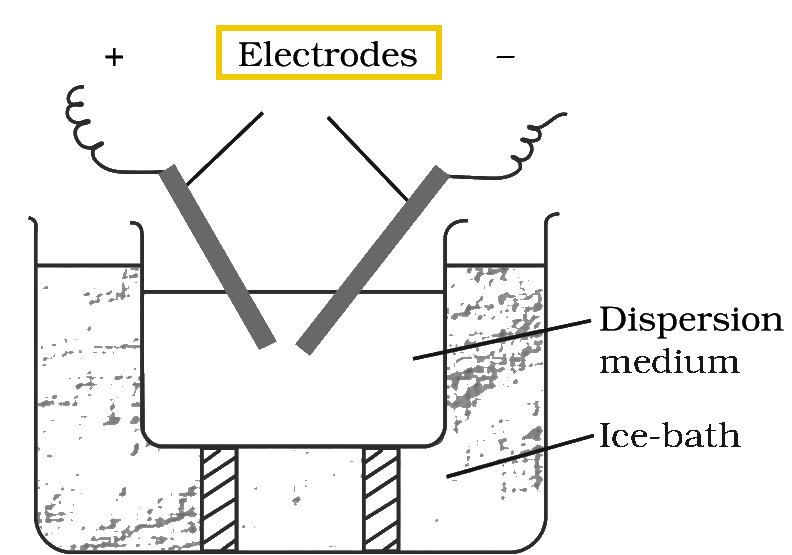
The correct answer is Option (3) → Electric arc is struck between the electrodes of the metal immersed in the dispersion medium.
The properties of colloidal solutions include colour, charge on the particles, Brownian movement, the Tyndall effect, electrophoresis and coagulation. Striking an electric arc between metal electrodes under the dispersion medium is Bredig’s arc method, a way of preparing sols of metals such as gold, silver and platinum.
Option (1) Finest gold sol is red in colour, as the size of particle increases, it appears purple, then blue and finally golden. — A property of a colloidal solution (colour). The colour of a sol depends on the wavelength of light scattered by its particles, which depends on their size.
Option (2) The charge on the sol particles is due to preferential adsorption of ions from solution. — A property of a colloidal solution (charge). Colloidal particles carry a charge, mostly because they adsorb the ions common to them.
Option (3) Electric arc is struck between the electrodes of the metal immersed in the dispersion medium. — Not a property of a colloidal solution (Bredig’s arc method of preparation). The intense heat of the arc vaporises the metal, and the vapour condenses into particles of colloidal size. This describes how a sol is made, not how a sol behaves.
Option (4) Colloidal particles always appear to be in a state of continuous zig-zag motion. — A property of a colloidal solution (Brownian movement). The motion is caused by the unbalanced bombardment of the particles by the molecules of the dispersion medium.
Note: This question is from the pre-rationalised NCERT book (2022-23). The topic is not there in the latest NCERT book (2026-27), and it is also out of the CUET 2026 syllabus.
NCERT (Pre-rationalised edition, 2022-23):
Electrical Disintegration or Bredig’s Arc Method – “This process involves dispersion as well as condensation. Colloidal sols of metals such as gold, silver, platinum, etc., can be prepared by this method. In this method, electric arc is struck between electrodes of the metal immersed in the dispersion medium (Fig. 5.8). The intense heat produced vapourises the metal, which then condenses to form particles of colloidal size.”
Properties of Colloidal Solutions – “… (iii) Colour: The colour of colloidal solution depends on the wavelength of light scattered by the dispersed particles. The wavelength of light further depends on the size and nature of the particles. … Finest gold sol is red in colour; as the size of particles increases, it appears purple, then blue and finally golden.
(iv) Brownian movement: When colloidal solutions are viewed under a powerful ultramicroscope, the colloidal particles appear to be in a state of continuous zig-zag motion all over the field of view. …
The charge on the sol particles is due to one or more reasons, viz., due to electron capture by sol particles during electrodispersion of metals, due to preferential adsorption of ions from solution and/or due to formulation of electrical double layer.”