
Which of the following will have a highest Eo value?
Answer & explanation
Correct answer: option 3
The correct answer is Option (3) → Mn3+/Mn2+
The standard electrode potential E°(M3+/M2+) measures how easily M3+ is reduced to M2+. A large positive value means M3+ readily gains an electron, so M2+ is the more stable ion. A negative value means M2+ readily loses an electron, so M3+ is the more stable ion. The value depends largely on the stability of the d-electron configuration of the two ions.
Mn (Z = 25) is [Ar]3d54s2; removing the two 4s electrons and one 3d electron gives \( \ce{Mn^{3+}} \): 3d4. On gaining one electron it becomes \( \ce{Mn^{2+}} \), 3d5, which is a half-filled d subshell with extra stability. So \( \ce{Mn^{3+}} \) is strongly oxidising, and among the given couples Mn3+/Mn2+ has the highest E° value.
Why the other options are incorrect
Option (1) Cr3+/Cr2+ — Incorrect. Cr (Z = 24) is [Ar]3d54s1; losing three electrons gives \( \ce{Cr^{3+}} \): 3d3, which has a stable half-filled t2g level, so \( \ce{Cr^{2+}} \) is a reducing agent and E° is negative (−0.41 V).
Option (2) Sc3+/Sc2+ — Incorrect. Sc (Z = 21) is [Ar]3d14s2; losing all three electrons gives \( \ce{Sc^{3+}} \) the stable noble gas configuration [Ar], and \( \ce{Sc^{2+}} \) is practically unknown. \( \ce{Sc^{3+}} \) has no tendency to be reduced, so the value is strongly negative.
Option (4) Ti3+/Ti2+ — Incorrect. Ti (Z = 22) is [Ar]3d24s2, so \( \ce{Ti^{2+}} \) is 3d2 and \( \ce{Ti^{3+}} \) is 3d1. \( \ce{Ti^{2+}} \) is easily oxidised to \( \ce{Ti^{3+}} \), so E° is negative (−0.37 V).
NCERT (2026-27 edition):
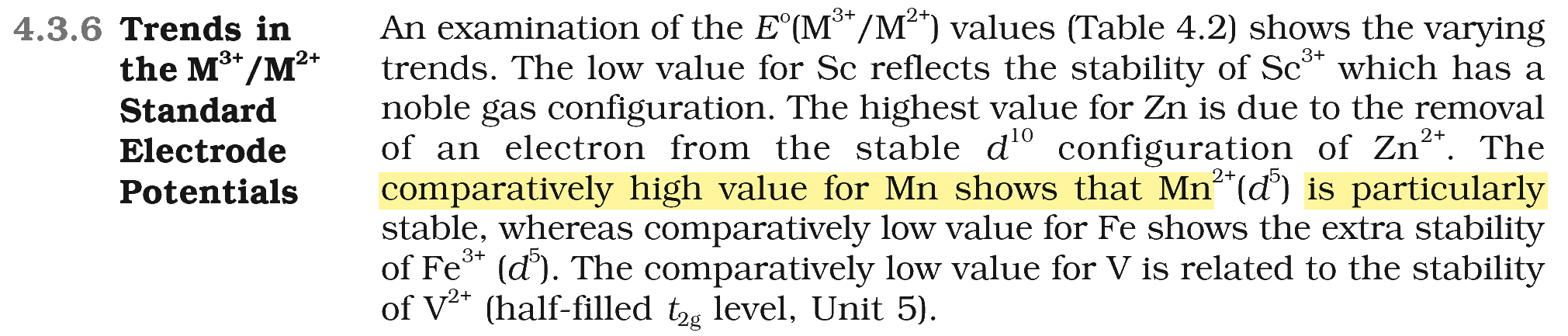
Trends in the M3+/M2+ Standard Electrode Potentials
| Element | Sc | Ti | V | Cr | Mn | Fe | Co | Ni | Cu | Zn |
|---|---|---|---|---|---|---|---|---|---|---|
| E°/V, M3+/M2+ | – | −0.37 | −0.26 | −0.41 | +1.57 | +0.77 | +1.97 | – | – | – |